Remembering Felix Patrick Dempsey Part 3

Felix’s life after his discharge from the Army

What Felix did in the years immediately after his discharge from the Army is unknown, for his name does not appear in any newspapers or other records. I like to think that he returned to Port Pirie, got a job and took care of his father in the final years of his life. Michael Andrew Dempsey died on 19 February 1925 in Port Pirie. We next hear of Felix when, on 1 December 1928, he married Alvera Hulda Falkenberg at a Registry Office in Adelaide. Felix was aged 32 and his bride was 22. Alvera was the fifth child of Julius Birthold Falkenberg and Emma Louise Kliche who had settled in the Barossa Valley. The marriage did not last, but I do not know when it ended.

This story does not have a happy ending, for in the 1930’s Felix’s life appears to have unravelled. The “shell shock” he suffered after serving on Gallipoli may have returned to haunt him. The term “shell shock” was coined in 1915 and is now recognized as post-traumatic stress disorder, PTSD, a psychological response to the stress of combat. Many soldiers who had witnessed trauma or experienced shell shock attempted to ‘self-medicate’ their symptoms with alcohol and drugs. PTSD had a long-term impact on many veterans of the First World War. At the end of this war the men who served in combat were not given any support to help them to return to civilian life. They suffered disabilities for the rest of their lives, including depression, alcoholism and severe social dislocation. They struggled to maintain relationships, jobs and general mental stability.

The  generation  of  young  men  who  fought  in  the  First  World  War  were  hit  with  a  second  catastrophe  in  their  lives  with  the  arrival  of  the  Great  Depression.  South  Australia  suffered  more  than  any  other  state  through  the  worst  years  of  the  Depression,  with  the  official  level  of  unemployment  rising  to  35.4%  in  1932.  Nationwide,  the  figure  for  unemployment  reached  a  peak  of  32%  in  1932.  By  1933  nearly  one-third  of  breadwinners  were  unemployed.1  It  seems  quite  likely,  therefore,  that  Felix  was  one  of  many  men  who  lost  their  jobs  and  became  unemployed.

The added stress of unemployment could have been enough to lead Felix to despair. There were no unemployment benefits in the 1930s. Suicide rates increased dramatically. Studies have shown a direct causal relationship between unemployment and suicide rates, not just during the Depression, but still occurring today.2

Records show numerous instances of Felix getting into trouble with the police in the 1930s. For example, in July 1934 Felix was in the Police Court in Mount Barker.

On Monday morning, Felix Patrick Dempsey, travelling tool sharpener, was brought before Mr.  G.  A.  I.  Liebing and charged with being a “noisy drunk.” He was arrested on Saturday night.

Sergt.  Koch, in evidence, stated, that the defendant was a noisy, pugilistic drunk, who had many previous convictions against him for vagrancy, and only last month he was released from gaol after having served three months for larceny.

The bench imposed a fine of £1 and 4/ costs, in default 7 days imprisonment in the Adelaide gaol.  The defendant elected to take the time out.3

This newspaper report tells us that Felix did not have a regular job: he was trying to support himself as a “travelling tool sharpener”.  He had previous convictions for vagrancy.  During the Depression many thousands of men were “vagrants”, wandering from place to place desperately seeking work and sleeping in public parks.  More than 40,000 men moved around the country looking for work: setting up shantytowns on the edges of communities and camping in parks.4

In September 1937 Felix was sentenced to five months imprisonment for stealing a bicycle.  He would have been in prison when his mother died on 12 December 1937.

Felix Patrick Dempsey, laborer, of Franklin Street, city, who admitted 28 previous convictions, was sentenced to imprisonment for five months by Mr Morgan.  S.M.  in the Adelaide Police Court yesterday, for having, on September 4 stolen a bicycle valued at £3, the property of the Adelaide Wine and Spirit Coy..  Ltd.  Assistant Police Prosecutor Dayman prosecuted.5

By 1939 Felix was in New South Wales in the small town of Grong Grong about 23 km east of Narrandera in the Riverina region. I remember Narrandera as a pleasant place to stop on the long drive from Canberra to Adelaide, but I wonder what purpose Felix had in this place in 1939, or if he was just a lost soul drifting through. On 6 January Felix Patrick Dempsey (45) was fined £1/10/, in default three days, on a charge of drunkenness at Grong Grong.6

With the outbreak of the Second World War, Felix enlisted again, on 11 December 1940, this time with the 8th Garrison Battalion at Shortland Camp, New South Wales. The 8th Garrison Battalion was responsible for coastal defence in and around the Newcastle region.

He was discharged on 5 February 1941. His record does not give reasons for his discharge. He would have been aged 47.
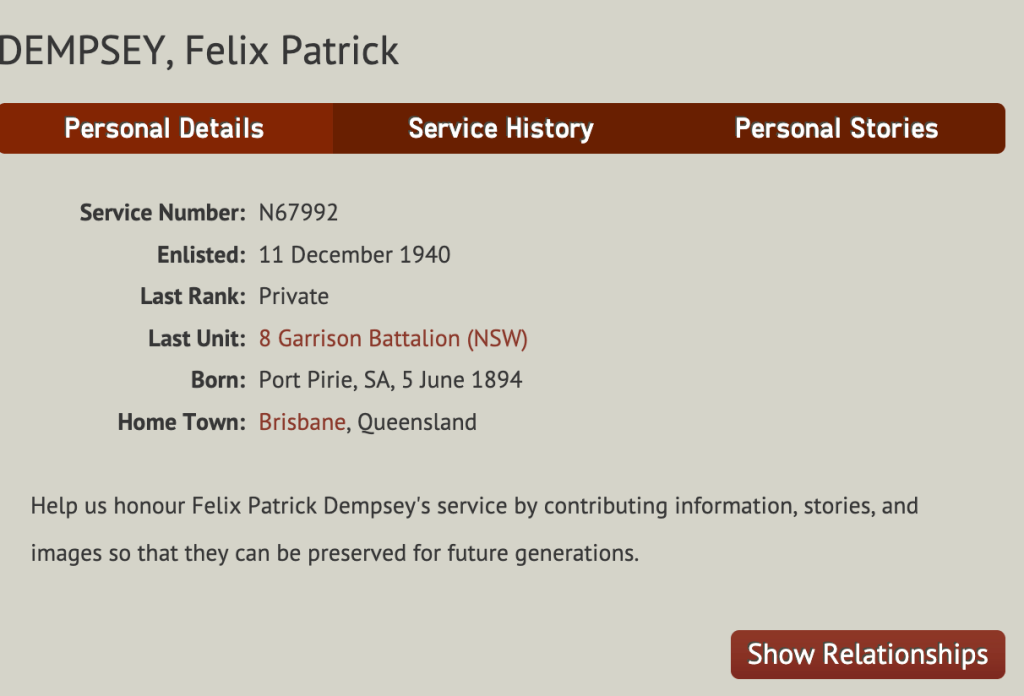
Service History. Virtual War Memorial Australia. https://vwma.org.au/explore/people/614501

He died in Brisbane Hospital the following year of “alcoholic leptomeningitis” which generally refers to the increased severity of bacterial meningitis in patients with chronic alcohol use disorder. His death certificate said that he was single, had no relatives, and lived at Moorooka Camp, a large Military camp set up by the United States Army Service of Supply during the Second World War.


While reading about the long-term disabilities suffered by World War I veterans, I came across an article which resonated with me.

Overall, we have a better understanding of what trauma is because of World War I.  Although modern treatments for PTSD are more effective than those for shell-shock, issues such as social stigma and alcohol misuse remain.  These are lessons from World War I we are still learning.  We must not forget the challenges facing service personnel exposed to trauma, both today and a century ago.7

Felix Patrick Dempsey’s burial place in Toowong Cemetery is far from his family roots in Ireland and South Australia.  Toowong Cemetery was established in 1866.  It is a beautiful heritage listed cemetery, established on a hilly site at the base of Mt Coot-tha.  It is set on a unique scenic landscape with numerous walking trails.  The Friends of Toowong Cemetery conduct tours and provide self-guided walks through the cemetery.  One day soon – for I live not far from Brisbane – I will visit Felix’ grave to pay my respects.  As I stand in front of his grave, I will tell him that he has not been forgotten, that he has family who still remember him with affection and respect.

I have been informed by the Office of Australian War Graves that the official plaque on Felix Patrick Dempsey’s grave will be inscribed as follows:
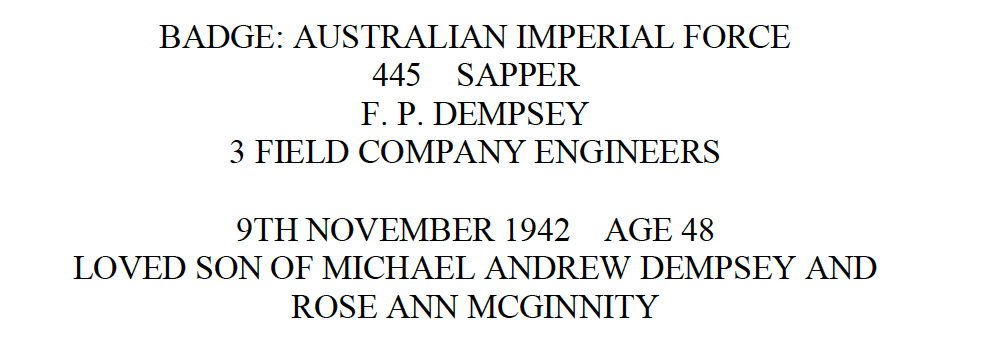

Lest We Forget

  1. Clark, Manning A short history of Australia (Fourth revised edition). Penguin Group Australia, Camberwell, Victoria, 2006, p. 266 ↩︎
  2. A study using data from 175 countries between 1991 and 2017 showed that for every 1% increase in unemployment, there was a 2–3% increase in suicide rates. Mark Sinyor, Morton Silverman, Jane Pirkis, Keith Hawton. “The effect of economic downturn, financial hardship, unemployment, and relevant government responses on suicide”, The Lancet Public Health, Volume 9, Issue 10, 2024, pp. 802–06. ↩︎
  3. “POLICE COURT, MOUNT BARKER.” The Mount Barker Courier and Onkaparinga and Gumeracha Advertiser (SA : 1880 – 1960) 20 July 1934: 2. Web. 30 Apr 2026 <http://nla.gov.au/nla.news-article146056566&gt;. ↩︎
  4. National Museum of Australia, https://www.nma.gov.au/defining-moments/resources/great-depression ↩︎
  5. “Prison For Stealing Cycle” The Advertiser (Adelaide, SA : 1931 – 1954) 11 September 1937: 30. Web. 30 Apr 2026 <http://nla.gov.au/nla.news-article30776182&gt;. ↩︎
  6. “MONDAY, JANUARY 2” Narandera Argus and Riverina Advertiser (NSW : 1893 – 1953) 6 January 1939: 1. Web. 30 Apr 2026 <http://nla.gov.au/nla.news-article130464164&gt;. ↩︎
  7. Benjamin Russell Butterworth, Glasgow Caledonian University. “What World War I taught us about PTSD”.The Conversation https://theconversation.com/what-world-war-i-taught-us-about-ptsd-105613 ↩︎
Remembering Felix Patrick Dempsey

Part 1

Felix Patrick Dempsey was born on 5 June 1894 in Port Pirie, South Australia. His parents were Michael Andrew Dempsey and Rose Ann McGinnity. He died in Brisbane on 9 November 1942, aged 48. Those are the bare facts of his life.

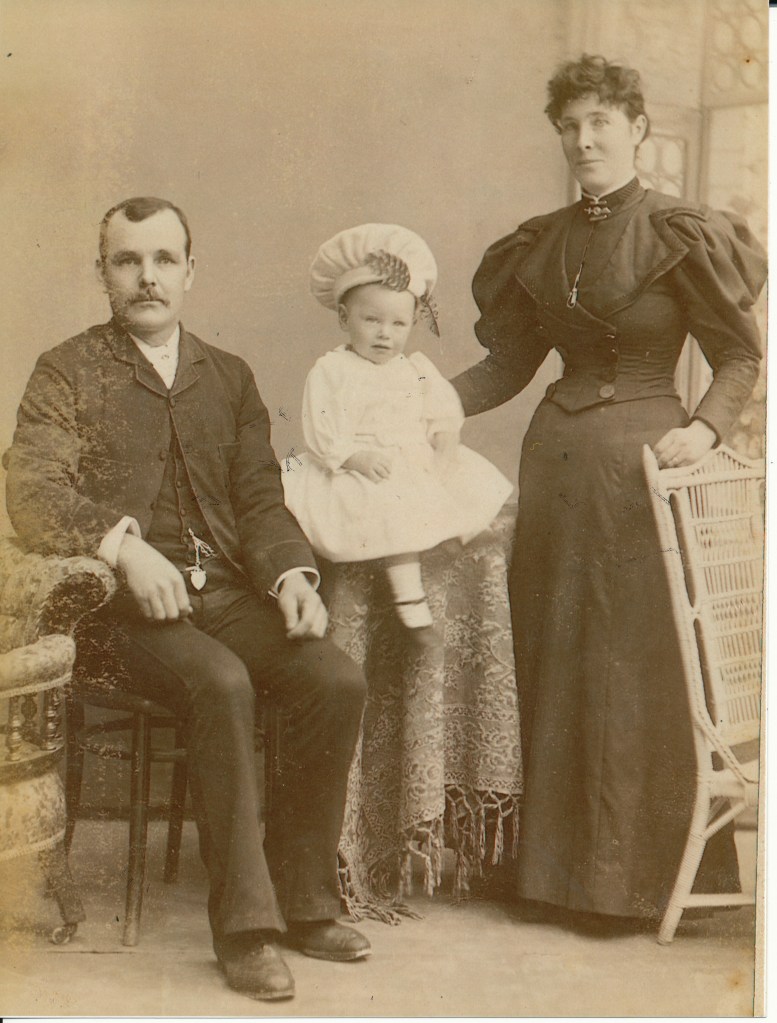
Felix Patrick Dempsey with his parents, Michael Andrew Dempsey and Rose Ann McGinnity. 1894 or 1895. He was their only child.
Felix Patrick Dempsey with his parents Michael and Rose. He was their only child. 1895. Personal photo collection.

He was not a close relative of mine. I have more than 150 Dempsey names in my family history database. So what brought me to examine the life of this distant cousin and decide that his story was worth telling and remembering?


The Australian Remembrance Army, founded in Brisbane in 2020, is a group of volunteers dedicated to ensuring that the service and contribution of men and women who left Australia to serve overseas and who did return, should not be forgotten.1 Katrina Trevethan is one of the Co-Founders of the Australian Remembrance Army. For five years, she and her fellow researcher Cate Walker have been voluntarily researching war veterans buried in unmarked graves at Brisbane’s heritage-listed cemeteries. To date, they have identified over 800 Great War (WWI) veterans in unmarked graves at Lutwyche Cemetery.

A couple of months ago I received a surprise message on the Ancestry website from Katrina. She had found a returned serviceman named Felix Patrick Dempsey on my Family Tree and wondered how I was related to him. In part her message said:

We’re now focusing on Toowong Cemetery, where over 600 WWI veterans lie in unmarked graves. I have submitted 200+ applications to the Repatriation Commission to be assessed to determine if the veteran is eligible for official commemoration, including one for FELIX. His application was approved, and his grave will soon be marked by the Office of Australian War Graves (OAWG), which will be cared for by them in perpetuity.

As part of the process, OAWG requests contact with a descendant before proceeding. If you are related to FELIX PATRICK DEMPSEY, I would greatly appreciate your assistance. There is NO COST involved—just your consent and contact details (email is fine) to share with OAWG so they can extend a formal offer of official commemoration to the descendant.

I confirmed that Felix Patrick Dempsey was a distant cousin of mine. His grandfather, Felix Dempsey and my 2X great grandfather John Dempsey were brothers. The Dempsey family were from County Cavan, Ireland and emigrated to South Australia in several family groups between 1849 and 1854. I said that I was grateful that my relative Felix Patrick Dempsey would be commemorated in the Toowong Cemetery.

I have since received an offer of official commemoration of Felix Patrick Dempsey from the Office of Australian War Graves, Department of Veterans’ Affairs. I felt privileged to be asked to complete and return the application form which will ensure that his grave will be formally marked at his actual burial location in Brisbane’s Toowong Cemetery: Section 10, Row 69, Grave No 25.

Family background of Felix Patrick Dempsey

Felix Patrick Dempsey’s grandfather, Felix Dempsey, was born in Cootehill, County Cavan, Ireland in 1825. He arrived in South Australia on the Joseph Rowan on 16 June 1854. He was accompanied by his parents, Thomas and Mary Dempsey, sisters Catherine and Mary and brother Thomas. Their arrival was the last of a pattern of chain migration of the Dempsey family to South Australia.

In 1858 John Dempsey (my 2X great-grandfather) and his younger brother Felix bought Section No. 36 in the Hundred of Upper Wakefield in their joint names. The section was of 224 acres and divided in half along east-west lines, with John and Felix each having 112 acres. It was located between Mintaro and Auburn. This was where they began their lives as farmers in South Australia.

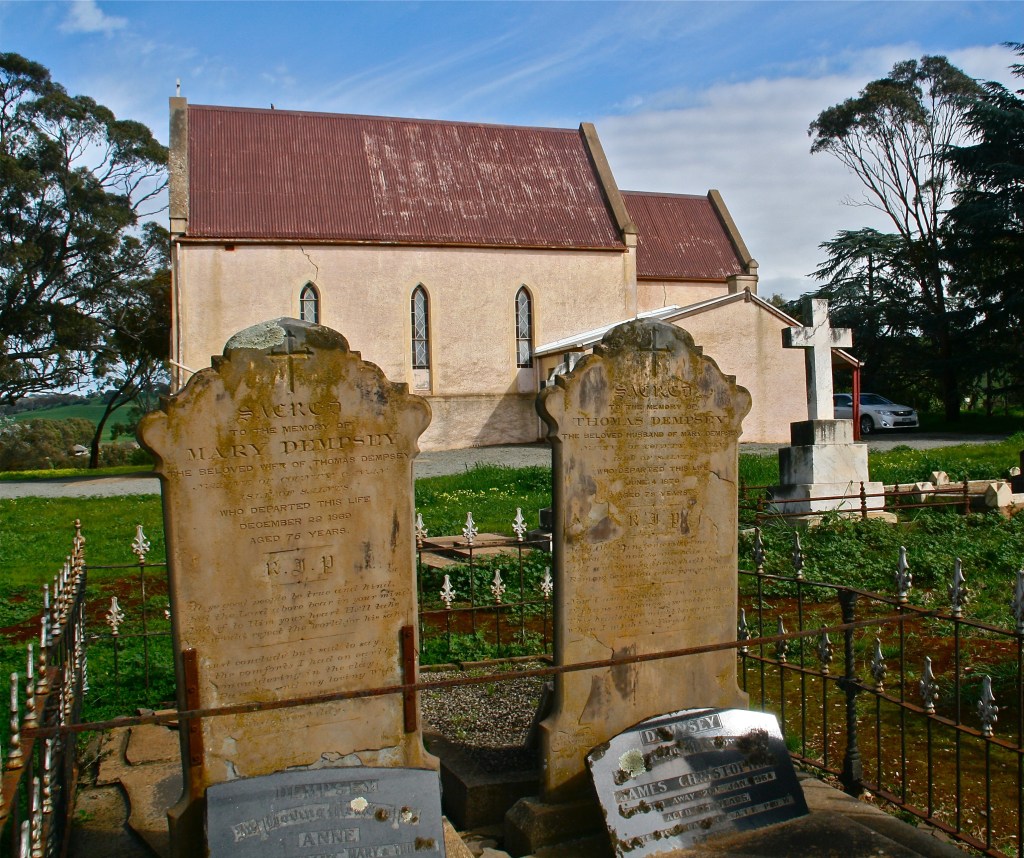
Felix married Elizabeth Tully on 30 July 1863 at the Church of the Immaculate Conception in Mintaro. This Church is significant in the Dempsey family history. The Dempseys were struggling early settlers battling to carve out a life for themselves in the new colony. Along with other pioneering Catholic families from the district around Mintaro they contributed to the cost of building this church which opened in 1856. It was served by the Jesuit priests from Sevenhill Parish. My 3X great grandparents, Thomas Dempsey (1792–1870) and Mary Tully (1794–1869) lie buried in the cemetery next to the church.2

The tombstones of my 3X great-grandparents, Thomas Dempsey 1792–1870 and Mary Tully 1794–1869 in the cemetery of the Church of the Immaculate Conception, Mintaro. They were the first generation of the Dempsey family to emigrate to South Australia.

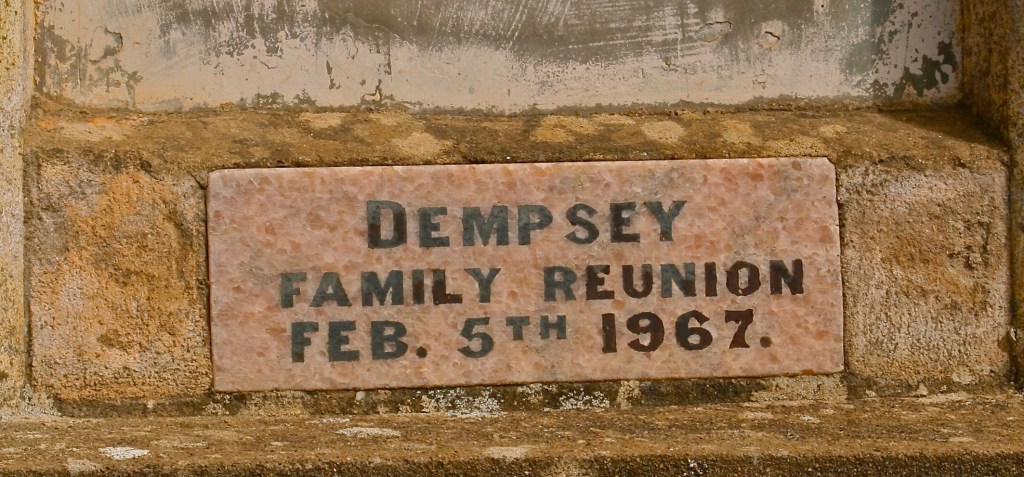
There is a plaque on the wall celebrating a Dempsey family reunion which took place in Mintaro in 1967.

Felix and Elizabeth had four sons and three daughters during their 11-year marriage. The youngest son died aged one month in 1873. Elizabeth died on 16 June 1874 leaving Felix with six children aged between ten and two years old. She was buried in the graveyard of the Mintaro church. When I visited this church and graveyard some years ago, I was touched by the inscription on her tombstone, even though at the time I did not know her story. I could sense Felix’ grief at the loss of his young wife.

To the memory of

Elizabeth Dempsey

the beloved wife of Felix Dempsey

Native of County Cavan, Isle of Saints

who departed this life

June 16, 1874 aged 38 years

Come all you people who pass by,

And on this Headstone cast an eye,

Repent in time, make no delay

For no one knows their dying day.

All you who pass will you kindly pray

For one whom you will meet on Judgement Day.3

Snatched from this dreary life,

In the twinkling of an eye,

My own dear loving wife

Will you look on me from high.

In one long night, she slept the sleep of death.

How lowly thou art laid,

My own dear loving wife

But I will meet again with thee

In that bright land above.

Felix never re-married. Somehow, he brought up his young family on his own, with the help of nearby relatives. The eldest child Mary probably devoted her youth to looking after her young siblings. She married at the age of 43 and never had a family of her own. Felix Patrick Dempsey’s father, Michael Andrew Dempsey (1868-1925) was four years old when his mother died.

Felix was a hardworking and enterprising farmer who purchased more sections in the Hundred of Upper Wakefield. These sections raised his holding to 511 acres. All these sections were contiguous and were separated from Section 36 only by a road. In 1874 Felix bought sections 342 and 343 containing 117 acres adjoining Mintaro township. He bought this property with the intention of living ther while still retaining oversight of his other properties so that his young children could be within easy reach of the Mintaro school run by the Sisters of Saint Joseph. In April 1884 my 2X great-grandfather John Dempsey disposed of his half interest in Section 36 to Felix for £5 10/- per acre. Felix was left as the sole owner of the original Dempsey homestead section.

When age began to take its toll, Felix retired from farming. His great-nephew Joe Dempsey wrote the following about Felix in 1933:

He removed to Port Pirie where his second son, Michael, had settled and remained under the shelter of his roof until death claimed him, a sturdy and hardened example of pioneering fortitude, a venerable as well as venerated stalwart of the Faith, in 1912 at the advanced age of 87 years. His remains were conveyed to Mintaro and laid to rest amid relatives in the cemetery there.3


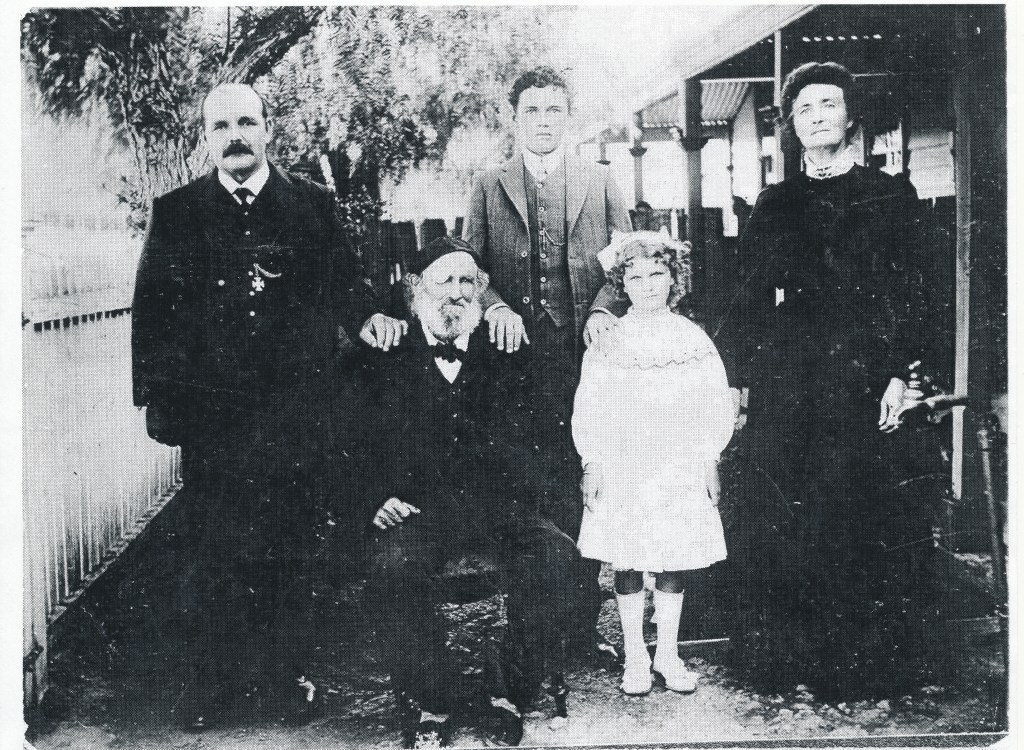
Standing: Michael Andrew Dempsey, Felix Patrick Dempsey, Rose Ann McGinnity. Seated in front, Felix Dempsey, the father of Michael Andrew Dempsey and grandfather of Felix Patrick Dempsey. The young girl is Elizabeth Charlotte Allen. Photograph taken in Port Pirie not long before the death of Felix Dempsey in 1912.

My next post will be about the service of Felix Patrick Dempsey in World War I.

  1. https://www.australianremembrancearmy.com/ ↩︎
  2. The Dempsey family is one of the families featured in this book. Lally, Gerald, A landmark of faith: Church of the Immaculate Conception Mintaro and its parishioners 1856-2006, Gerald A. Lally, Clare, S.Aust, 2006 ↩︎
  3. This is a traditional and powerful memento mori (a reminder of mortality) commonly found on 18th and 19th-century tombstones in English-speaking countries. ↩︎
  4. Joseph Dempsey, A Tribute to our Pioneer Ancestors: The Dempsey Family in South Australia, self-published, November 1933. Family collection. This book is also deposited in the National Library of Ireland and the GenealogySA Library. ↩︎