Featured

Thomas Greenough and the Green family in South Australia

“The City of Adelaide, from the Torrens near the Reed Beds” George French Angus. approximately 1846. State Library of South Australia B 15276/1. Out of copyright

A couple of months ago I published my family history book, Irish Settlers in South Australia: The Hayes and O’Toole Families. In the book I wrote briefly about the life of my great-great-aunt Mary O’Toole (1821–1881). Mary was my great–great–grandfather John Thomas O’Toole’s sister. Since then I have made more discoveries about Mary’s life and the mystery surrounding the convict past of her first husband Thomas Greenough. The article which emerged from my research, A man of many names, was published in The South Australian Genealogist Volume 47 No 4 November 2020. This blog post is a modified version of that article. It includes an Epilogue about the discovery of Mary O’Toole’s grave in 1990 by her great-grandson John Lawrence Green.

A man of many names

My 3X great-aunt Mary O’Toole was a young woman of 19 when she arrived in South Australia on 7 July 1840. Mary, her parents and brothers were passengers on the William Nicol, the first ship to sail directly from Dublin to South Australia.[1] The Taggart family from Dublin were also passengers on this ship. Mary was not to know that some years in the future, John Taggart would become her second husband. This story is about the early years of Mary’s life in South Australia, and in particular her marriage to her first husband, a ‘man of many names’.

  1. On 17 January 1842 Mary married in a Catholic ceremony in Adelaide.[2] The name of the groom on the marriage certificate was James GREENHAM. Both James and Mary made a declaration that they were Catholics. The celebrant was Father William Benson[3].
  2. On 6 April 1844 their son Thomas Peter Green was baptised. On the baptism record, the father’s name is given as Thomas GREEN. All of the six children of the marriage were given the surname Green.
  3. At the Coroner’s Inquest following his death on 6 May 1851, Mary’s husband was named as Thomas GREENOUGH.

Who was this man with multiple names?

James GREENHAM

I searched numerous records to see what I could learn about ‘James Greenham’. A James Greenham arrived in Adelaide on 27 November 1837 on the ship Eudora from Hobart via Pt Phillip.[4] I searched Trove to see if I could find out anything more about him, with a nil result.

There are eight Greenham names in the Biographical Index of South Australians, but they all relate to one couple, Henry Greenham, born circa 1811 in England and his wife Isabella Davis.[5] The other Greenham entries are for the children of this couple. There are no death or cemetery records for a James Greenham in South Australia.

After mulling over the problem for some time, it dawned on me that I may have been wasting my time searching for the name James Greenham in South Australia. The explanation for the  mystery could be very simple: a mistake on the marriage certificate. It is possible that when the celebrant or whoever was filling out the form asked for the groom’s name, this person mis-heard the name “Greenough” as “Greenham.” This could have happened very easily. (I know this from personal experience. I have an Indian last name and I have grown accustomed to it being mis-spelt and mis-pronounced for 45 years.) Such mistakes occurred frequently in the nineteenth century, when the hearer did not understand the phonetic delivery of the person speaking.

The first name ‘James’ on the marriage record is also likely to be a mistake. This reasoning is supported by an entry in The Biographical Index of South Australians, where his name is written as James (Thomas) Greenham.[6] Perhaps James was the name of a witness to the marriage. Civil Registration of births, death and marriages became compulsory in South Australia in July 1842, six months after the marriage took place, so the only evidence we have is the church record.

Thomas GREEN

A daughter named Martha was born in 1842, but there is no baptism record for her. On 6 April 1844 their first son Thomas Peter Green was baptised by Father Edmond Mahoney. The sponsors were Patrick and Mary Dehane. The father’s name was recorded as Thomas GREEN.
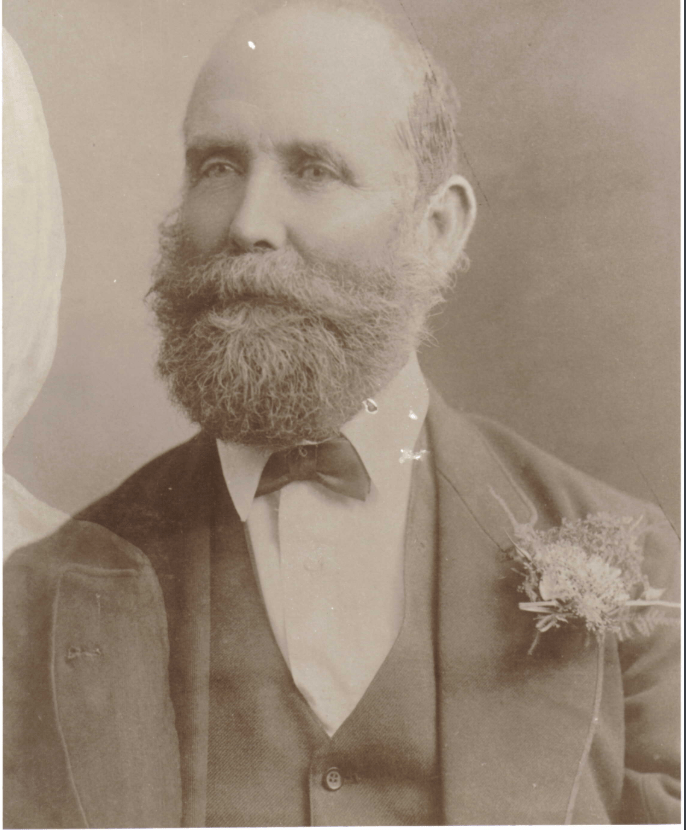
Thomas Peter Green 1844–1918, the eldest son of Thomas Greenough and Mary O’Toole. Date of photograph is unknown. Author photo collection.

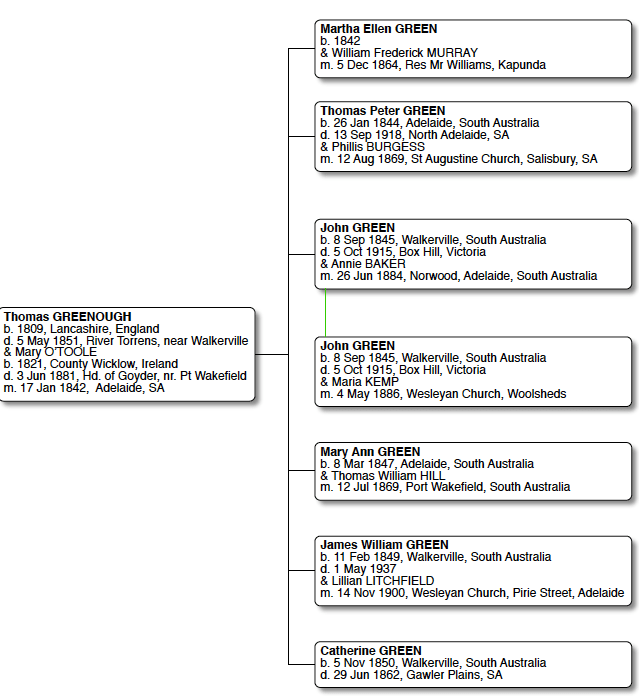
Following the births of Martha and Thomas Peter, four more children were born to Thomas Green and Mary O’Toole: John 1845, Mary Ann 1847, James William 1849 and Catherine 1850. All of the children of the marriage were given the GREEN surname. On each of the baptism records, the father’s name was given as Thomas GREEN and the mother’s name as Mary Toole.[7] None of these births was officially registered.
Thomas GREENOUGH

On 6 May 1851 Mary’s husband drowned in the River Torrens. At the Coroner’s Inquest, he was named as Thomas GREENOUGH. On Thomas Greenough’s death certificate he was described as a Labourer of Walkerville. The informant was the Coroner, Charles Bonney, MP of Norwood.[8]

I searched to see if I could find any information about people with the name of Greenhough living in South Australia in the mid-nineteenth century. I found records for only two families: James William Greenough and his wife Mary Jane Guy who arrived in 1849 on the ship Stebonheath from Plymouth. Unfortunately the passenger list for this ship, which may have held some valuable information, is lost. This couple had a daughter named Martha in September 1849. Baby Martha died less than a month old. A son named James William Greenough died aged 7 months in December 1851. The names Martha and James William also occur in the family of Thomas Greenough and Mary O’Toole, so perhaps this is an indication of a family connection. The second Greenough name I found was Joseph Greenough who arrived in 1852 on the Standard. I do not think this man has any connection to our Thomas Greenough.[9]

It was clear that Greenough is a very uncommon name in South Australia. The Greenough surname is an ancient name derived from a geographical locality in the Lancashire region of England. I decided to broaden my search for the identity of Thomas Greenough.

On 3 August 1829 a Thomas Greenough was convicted at the Lancaster Quarter Sessions of stealing chickens. He was sentenced to seven years transportation to Van Diemen’s Land. On 15 December 1829 he sailed on the ship Mary with 167 other convicts. The Mary, a small ship of 361 tons, made seven voyages between 1819 and 1836 carrying convicts to Van Diemen’s Land. The average sentence of the convicts on Thomas Greenough’s voyage was 10 years. Fifty-one of the convicts on board had been sentenced to life sentences.

The Mary arrived in Van Diemen’s Land on 10 April 1830. Soon after arrival, the convicts were processed: a detailed physical description was made and their occupation or skills recorded so it could be determined where they would be sent to work. There are four convict records for Thomas Greenough: the Appropriation List, Conduct Record, Description List and Muster Roll.[10] These records yield the following information: Convict No 641. Age 21. Trade: Ploughman. Place where tried: Lancaster. Native place: Prescot, Lancashire. Height (without shoes) 5 feet 6 inches. Grey eyes, dark complexion, a long face.

Thomas Greenough had a very poor conduct record. Between 1830 and 1835 some of the offences recorded on his Conduct Record were: repeated insolence and neglect of duty, neglect of duty and general misconduct and being absent from his post without leave. His punishments grew more severe over time: from 25 lashes to 50 lashes to 75 lashes and being sent to hard labour on a chain gang for 12 months. In October 1835 he was charged with having a loaf of bread concealed under his jacket for which he could not satisfactorily account and a month later he was charged with being absent from his post, for which he was sentenced to the treadwheel for 6 days. The sentencing magistrate in most instances was Richard Willis.

There are no records for Thomas Greenhough’s departure from Tasmania, so he may have left under another name. I have not found his Ticket of Leave or Certificate of Freedom.  On 19 December 1836 a Thomas Green departed from Launceston on the schooner Eagle bound for Port Phillip.[11] This would have been a few months after Thomas Greenough completed his seven year sentence. When he arrived in South Australia may never be known, as records were not kept for domestic arrivals.

Background to his death

On Friday 9 May 1851, there was a report of a “Disappearance” in an Adelaide newspaper.

On Monday night a Port carman named Green, whose family live at Walkerville, left home and has not since been heard of. He had been drinking very copiously and it is feared has met with some accident. The police are in search of him.[12]

On Sunday 12 May there was another newspaper report that a Mr J. W. McDonald had discovered the body in a hole in the River Torrens near his residence where it had been for almost a week. He immediately called for assistance ‘and on the body being taken out he identified it as being that of Thomas Greenough.’ The inquest was held at the Sussex Arms in Walkerville on the same day ‘owing to the decomposed state in which the remains of the deceased were taken from the river.’[13] The publican, Charles Harvey Earle stated that the deceased came to his hotel:

about 11 o’clock on the night of the 5th May, in company with two men named Alfred Ward and William Hill: they remained until 1 o’clock on Tuesday morning. The deceased went away by himself; he had apparently been drinking before he came to witness’s house, but he was not intoxicated then, or even when he left. The night was very dark, and it was raining when deceased started for home.

J. W. Macdonald, giving evidence stated that, on attempting to cross the river about 7.30 on the following Sunday morning, six days after the disappearance of Thomas Greenough, he observed a round substance in the water, which, on examination, he discovered to be the head of a submerged human body. There were no marks of injury on the body, apart from some scratches on the forehead. The Jury returned a verdict of accidental death.[14]

We don’t know if Thomas’ late night drinking on the night of his death was an isolated occurrence or part of a regular pattern of behaviour. Mary was at home with six very young children, the eldest Martha aged about eight, and the youngest Catherine aged six months. One can only try to imagine Mary’s worry when he did not return home and continued to be missing for the next week.

 Mary’s personal circumstances at this time were difficult, for she was alone and did not have the support of her extended family. In their early years in Adelaide, the O’Tooles lived in Walkerville, but in the autumn/winter of 1848 Mary’s parents and brothers moved to an 80 acre farming block near Salisbury. For reasons unknown, Mary, Thomas and their children remained in Walkerville. Two more children were born after the departure of the rest of the family to Salisbury: James William in February 1849 and daughter Catherine in November 1850. At the time of his death, Thomas Greenough was working as a “carman,” a driver of a horse-drawn vehicle used for transporting goods, the equivalent to a labouring job – which is the occupation given on his death certificate.

Thomas Greenough was buried in an unmarked grave in an unknown location. In 1990, Ruth Green (wife of John Lawrence Green, a great-grandson of Thomas Greenough and Mary O’Toole) wrote letters to the Works Supervisor at West Terrace cemetery, the research co-ordinator at the South Australian Genealogy and Heraldry Society and the Archivist of the Adelaide Archdiocese. None of them could find any trace of a burial for Thomas Greenough. A letter from the Adelaide Archdiocese Archivist stated that “In Thomas’s case, it is possible, given the circumstances of his death and the harshness of Church law at the time, that he was not buried by a priest. If that is so, and his family was too poor to be able to afford a headstone for his grave, I am afraid that we will never be able to locate it.”[15]

His age on his death certificate was recorded as 38 years. The Coroner, Charles Bonney, MP was the informant, but he may not have known Thomas Greenough’s correct age. It is more likely he was aged 42 years. Thomas Greenough was aged 21 when he arrived in Van Dieman’s Land in 1830. As accurate records were kept in the convict system I am inclined to accept that his year of birth was 1809. I also found a baptism record for a Thomas Greenough which took place on 4 June 1809 in St Helens Lancashire.[16] St Helens is about 5 km from Prescot, the town given as Thomas Greenough’s native place on his convict record.

Mary’s life after the death of Thomas Greenough

When Thomas Greenough died in May, Mary faced the winter months trying to provide for her small children. I can’t imagine how she survived the next eighteen months. On 22 December 1852 Mary married John Taggart, a widower. John Taggart’s first wife Bridget Cleary and their infant daughter Margaret died in 1848.

The error of her husband’s name on her first marriage certificate may have caused problems for Mary when  she wished to re-marry. The baptism records for her children may have proved useful in convincing the Catholic Church that her married name was GREEN, not GREENHAM. Her name as recorded on her marriage to John Taggart is Mary GREEN, not Greenham. My great-great grandmother Ellen O’Toole was a witness to the marriage and the celebrant was Father Michael Ryan.

Soon after their marriage, John and Mary Taggart moved to the Salisbury area where they lived close to the rest of the O’Toole family. I imagine this must have been a comfort to Mary. Her youngest daughter Catherine Green died aged 12 years, but the other five children lived to adulthood. Mary had six more children with her second husband. She was to face many more challenges in her life, but that is another story.

My analysis of the evidence

When I began pursuing this story, I was sceptical as to whether Thomas Greenough the convict and Thomas Greenough who drowned in the River Torrens were the same person. I now believe, on the balance of probability, that they were the same person.

One aspect of this case which made the search easier is that Greenough is a very uncommon name in Tasmania and South Australia. Ordinarily one expects families to take a degree of pride in the family name, especially if it is unusual and of an ancient lineage. Thomas Greenough had three sons to carry on the family name, yet it appears that he wanted his children to have the common surname Green, and the unusual surname Greenough to disappear from the family tree. The name Green is very numerous in South Australia. There are six pages of Greens in the South Australian Biographical Index covering many families. A search of the surname Green on the database of the Genealogy and Heraldry Society of South Australia reveals 1572 birth registrations, 966 marriage registrations, 1268 death registrations and so on for the Green surname.

Perhaps Thomas Greenough struggled with grief, guilt and shame for being transported as a convict to Van Diemen’s Land. It is sad to reflect that in the period in which he lived, the shame of having a convict past led him to keep his family name and heritage a secret from his children and their descendants. Today we can look with compassion on the harsh sentence meted out to a young man for the crime of stealing chickens, presumably because his family was poor and hungry. He then endured the horror of harsh penal servitude for what appear to be minor offences.

Thomas Greenough almost succeeded in obscuring his past, were it not for the inquest into his death which lead to a trail of evidence waiting to be discovered by a curious researcher delving into his past 170 years after his death.

Epilogue

On a hot summer day in 1990, Mary O’Toole’s great-grandson John Lawrence Green and his wife Ruth went in search of her burial place. Ruth Green (nee Hewitt) wrote a poignant description of their efforts to locate Mary’s grave.

Early in the year 1990 Jack and I spent a day in the Balaklava and Port Wakefield area searching for the grave sites of Jack’s two great-grandmothers; namely Mary Taggert, formerly Green, born Toole; and Mary Ann Chatfield, born Burgess. With the help of the information I had already researched we had no problem finding the grave of Mary Ann Chatfield in a large family plot in the Balaklava cemetery. The headstone was very informative and we learned more family history from the inscription.

At the District Council of Wakefield Plains, we could get little help about Mary Taggert except her plot was No. 24, Catholic section in the OLD cemetery at Port Wakefield. We journeyed across to Port Wakefield and spent a very trying afternoon. We made five house calls to various identities, some saying there was no old cemetery, others not telling us where we could locate it. We were sent out to the present day cemetery, told it would have to be there as there was nothing left of the old cemetery. It was sold years ago, now belonged privately and was a stock paddock. We went to the present day cemetery also knowing this was not the place we were looking for. It was a very hot day and the air-conditioner in the car had broken, but Jack insisted we go back to Port Wakefield and continue our search.

We went to a dear lady we had been told about, a Mrs Underwood. She told us there was an OLD cemetery and where to go to find it. Two more house stops for directions and we ended in a very sad place, in the middle of a swamp, salt bush, stock paddock. There were remains of graves, broken slate, wrought iron surround, concrete, a couple of broken head stones with writing. We searched and walked to the corner of the paddock nearest, knowing each denomination in the early years had separate burial allotments. No luck. We walked back and while I photographed the ruins, Jack drove by car to the far corner of the paddock, coming back to tell me he had found it.

We stood at Mary’s gravesite in awe and sadness. It was dilapidated and vandalized. Why had this old cemetery been allowed to disintegrate in this way? We vowed this day to restore Mary’s grave. It was from her our present day Green family generated.

The lonely grave of Mary O’Toole in what was once the Old Port Wakefield Cemetery. It is now private land and little trace remains of the cemetery. Photo credit: Riverton History Centre, Riverton, SA. April 2017

There are photographs of the gravesite as they found it on that day. There were obscene words chipped into the headstone and what appeared to be bullet holes. Jack and Ruth re-visited the gravesite, retrieved the headstone and delivered it to a Monumental Mason for repair and restoration. The gravesite has been tidied up and fenced off. It sits all alone in the middle of a paddock. Of the other 26 graves there is not much evidence that they ever existed.


[1]     I have written about the O’Toole family in my book, Irish Settlers in South Australia: The Hayes and O’Toole Families.

[2]     James Greenham and Mary Toole, Marriage Certificate, 17 January 1842, Roman Catholic Church Register, Adelaide, Certificate No. 1. The Library and Research Centre of the South Australian Genealogy and Heraldry Society has this record on fiche. The originals are held in the Archives of the Catholic Archdiocese in Wakefield St, Adelaide.

[3]     Father William Benson had arrived in Adelaide on the Dorset on 14 February 1841.

[4]           Early Shipping and Passenger Lists, FamilyHistorySA. https://www.familyhistorysa.org/shipping/passengerlists.html

[5]      Biographical Index of South Australians 1836-1885, Jill Statton (ed.) Adelaide, South Australian Genealogy and Heraldry Society, 1986.

[6]      The Biographical Index of South Australians has a listing for James (Thomas) Greenham, religion Roman Catholic, marriage to Mary Toole on 17 January 1842 and a child, Martha born in 1842.

[7]     Letter from Sister Marie Therese Foale, Adelaide Archdiocesan Archivist, Catholic Diocesan Centre, Wakefield Street, Adelaide. 4 October 1988. Family records compiled by Ruth Green, Leaves from a branch of the Green tree, Descendants of Thomas Peter and Phillis Green, 1990, page 6

[8]     Thomas Greenough, Death Certificate, 5 May 1851, South Australia Registrar of Births, Deaths and Marriages, Book/page 2/82.

[9]     He was a miner and storekeeper in Kapunda. His religion was Wesleyan. He died aged 61 in 1875 in Kapunda.

[10]   Appropriation List CON27/1/4 Image 94/Image 98; Conduct Record CON31/1/16 Image 5; Description List CON18/1/15 page 184; Muster Roll CSO1/1/361 page 8292. The full convict record of Thomas Greenough can be found here: https://librariestas.ent.sirsidynix.net.au/client/en_AU/all/search/results?qu=greenhough&qf=NI_INDEX%09Record+Type+%28Names+Index%29%09Convicts%09Convicts

[11]   Thomas Green. Departures. Departure Port: Launceston. Record ID: Name_Indexes: 555633. Resource: POL458/1/2p55 . Libraries Tasmania website. https://librariestas.ent.sirsidynix.net.au/client/en_AU/names/search/results?qu=green&qu=thomas&qf=NI_INDEX%09Record+type%09Departures%09Departures&st=PA&isd=true

[12]   “Local News.” South Australian (Adelaide, SA : 1844 – 1851) 9 May 1851, p 2.

[13]   “A Man Found Drowned.” South Australian Register (Adelaide, SA : 1839 – 1900) 12 May 1851, p 2.

[14]     “Report of Coroner’s Inquest.” South Australian Register, (Adelaide, SA : 1839 – 1900) 13 May 1851, p 3.

[15]   Sister Marie Therese Foale, Adelaide Diocesan Archivist, 28 March 1990.

[16]   Transcription of the 1809 Baptism record of Thomas Greenough found on FindMyPast. https://www.findmypast.co.uk/transcript?id=R_9605797189
Remembering Felix Patrick Dempsey

Part 1

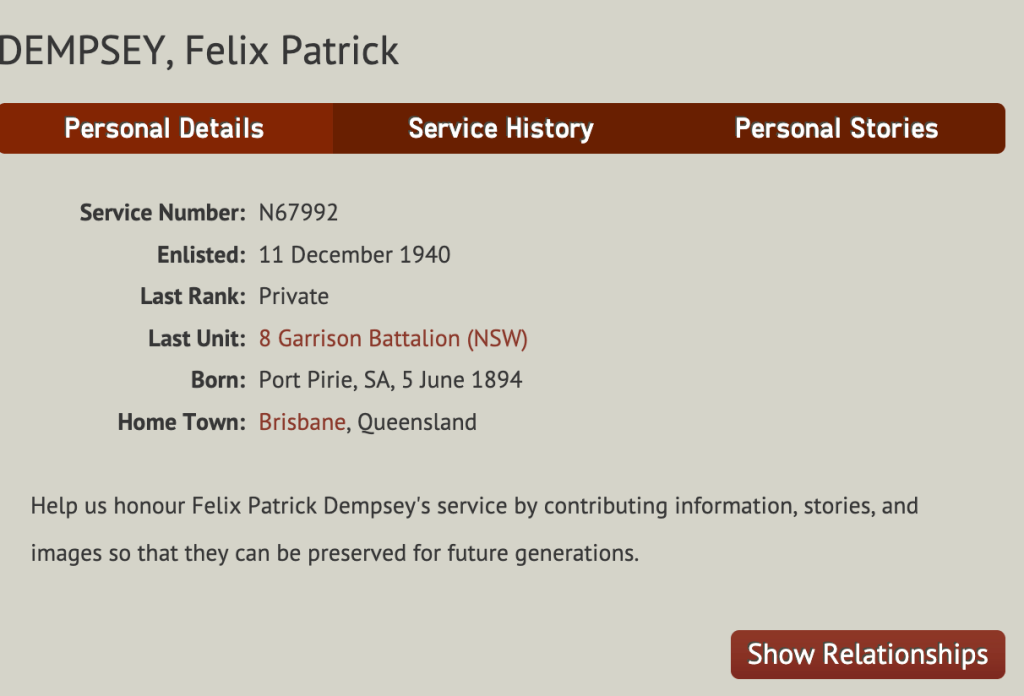
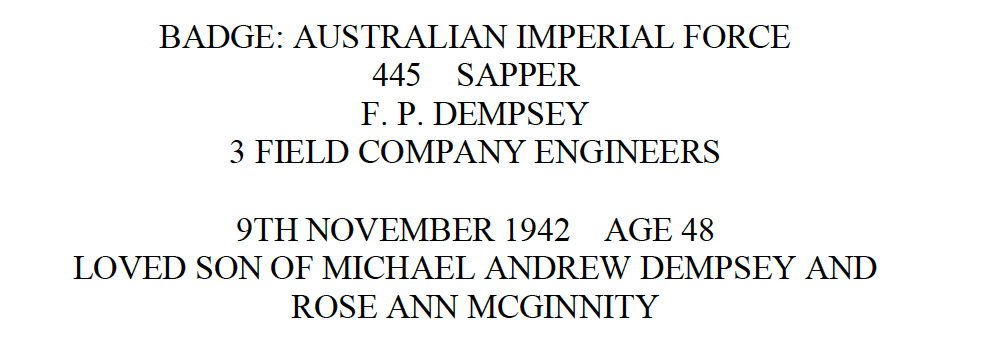
Felix Patrick Dempsey was born on 5 June 1894 in Port Pirie, South Australia. His parents were Michael Andrew Dempsey and Rose Ann McGinnity. He died in Brisbane on 9 November 1942, aged 48. Those are the bare facts of his life.

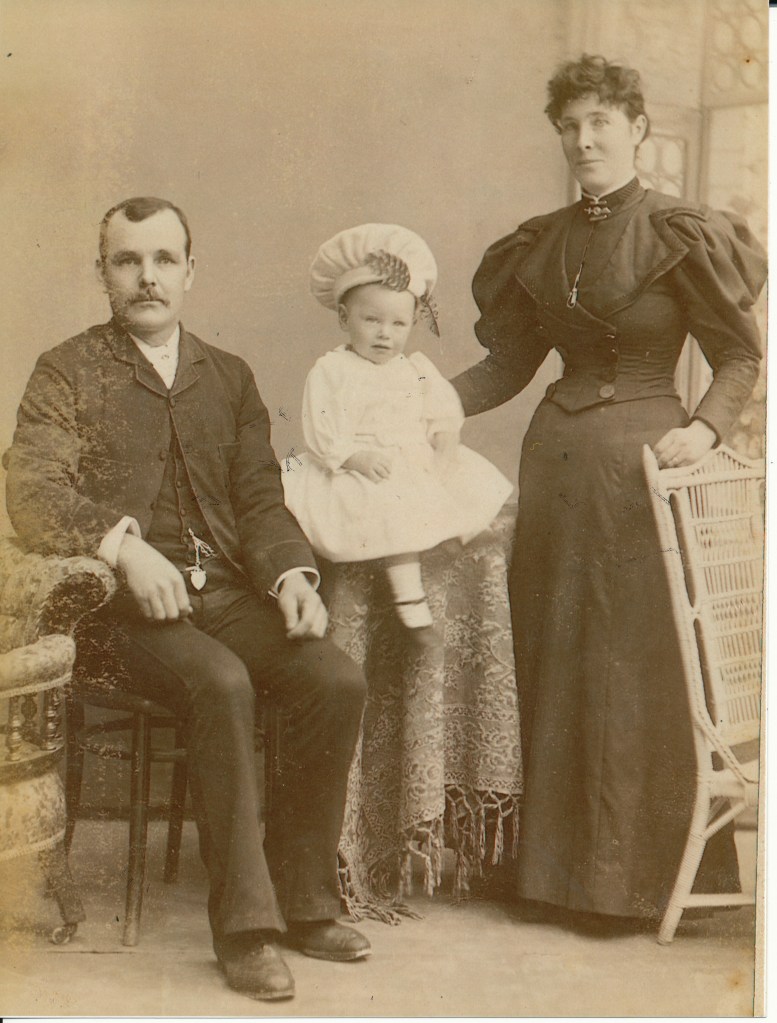
Felix Patrick Dempsey with his parents, Michael Andrew Dempsey and Rose Ann McGinnity. 1894 or 1895. He was their only child.
Felix Patrick Dempsey with his parents Michael and Rose. He was their only child. 1895. Personal photo collection.

He was not a close relative of mine. I have more than 150 Dempsey names in my family history database. So what brought me to examine the life of this distant cousin and decide that his story was worth telling and remembering?


The Australian Remembrance Army, founded in Brisbane in 2020, is a group of volunteers dedicated to ensuring that the service and contribution of men and women who left Australia to serve overseas and who did return, should not be forgotten.1 Katrina Trevethan is one of the Co-Founders of the Australian Remembrance Army. For five years, she and her fellow researcher Cate Walker have been voluntarily researching war veterans buried in unmarked graves at Brisbane’s heritage-listed cemeteries. To date, they have identified over 800 Great War (WWI) veterans in unmarked graves at Lutwyche Cemetery.

A couple of months ago I received a surprise message on the Ancestry website from Katrina. She had found a returned serviceman named Felix Patrick Dempsey on my Family Tree and wondered how I was related to him. In part her message said:

We’re now focusing on Toowong Cemetery, where over 600 WWI veterans lie in unmarked graves. I have submitted 200+ applications to the Repatriation Commission to be assessed to determine if the veteran is eligible for official commemoration, including one for FELIX. His application was approved, and his grave will soon be marked by the Office of Australian War Graves (OAWG), which will be cared for by them in perpetuity.

As part of the process, OAWG requests contact with a descendant before proceeding. If you are related to FELIX PATRICK DEMPSEY, I would greatly appreciate your assistance. There is NO COST involved—just your consent and contact details (email is fine) to share with OAWG so they can extend a formal offer of official commemoration to the descendant.

I confirmed that Felix Patrick Dempsey was a distant cousin of mine. His grandfather, Felix Dempsey and my 2X great grandfather John Dempsey were brothers. The Dempsey family were from County Cavan, Ireland and emigrated to South Australia in several family groups between 1849 and 1854. I said that I was grateful that my relative Felix Patrick Dempsey would be commemorated in the Toowong Cemetery.

I have since received an offer of official commemoration of Felix Patrick Dempsey from the Office of Australian War Graves, Department of Veterans’ Affairs. I felt privileged to be asked to complete and return the application form which will ensure that his grave will be formally marked at his actual burial location in Brisbane’s Toowong Cemetery: Section 10, Row 69, Grave No 25.

Family background of Felix Patrick Dempsey

Felix Patrick Dempsey’s grandfather, Felix Dempsey, was born in Cootehill, County Cavan, Ireland in 1825. He arrived in South Australia on the Joseph Rowan on 16 June 1854. He was accompanied by his parents, Thomas and Mary Dempsey, sisters Catherine and Mary and brother Thomas. Their arrival was the last of a pattern of chain migration of the Dempsey family to South Australia.

In 1858 John Dempsey (my 2X great-grandfather) and his younger brother Felix bought Section No. 36 in the Hundred of Upper Wakefield in their joint names. The section was of 224 acres and divided in half along east-west lines, with John and Felix each having 112 acres. It was located between Mintaro and Auburn. This was where they began their lives as farmers in South Australia.

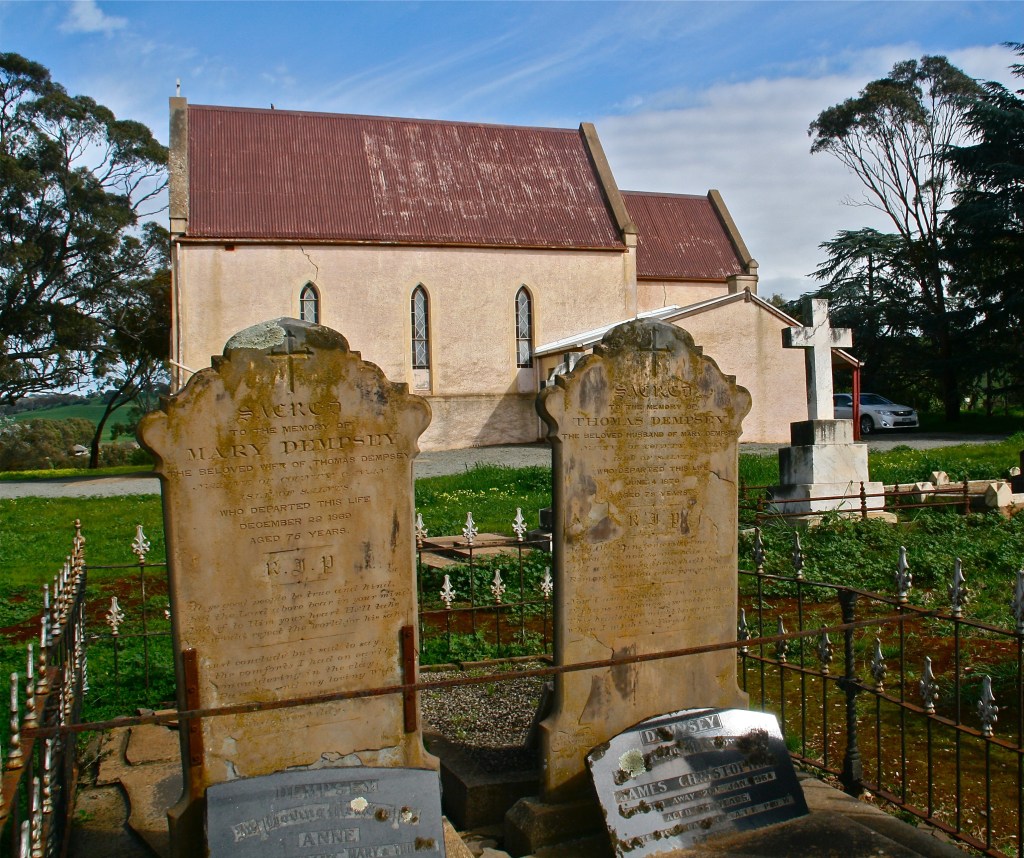
Felix married Elizabeth Tully on 30 July 1863 at the Church of the Immaculate Conception in Mintaro. This Church is significant in the Dempsey family history. The Dempseys were struggling early settlers battling to carve out a life for themselves in the new colony. Along with other pioneering Catholic families from the district around Mintaro they contributed to the cost of building this church which opened in 1856. It was served by the Jesuit priests from Sevenhill Parish. My 3X great grandparents, Thomas Dempsey (1792–1870) and Mary Tully (1794–1869) lie buried in the cemetery next to the church.2

The tombstones of my 3X great-grandparents, Thomas Dempsey 1792–1870 and Mary Tully 1794–1869 in the cemetery of the Church of the Immaculate Conception, Mintaro. They were the first generation of the Dempsey family to emigrate to South Australia.

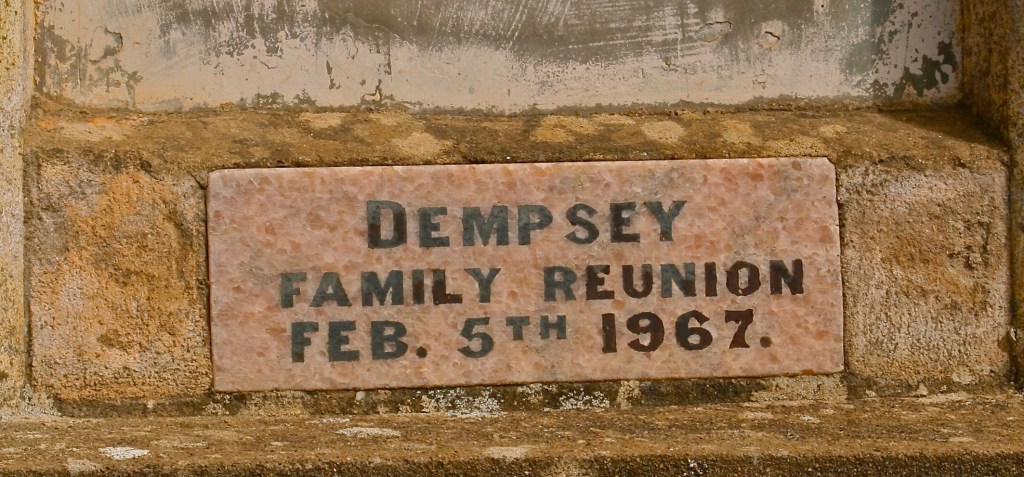
There is a plaque on the wall celebrating a Dempsey family reunion which took place in Mintaro in 1967.

Felix and Elizabeth had four sons and three daughters during their 11-year marriage. The youngest son died aged one month in 1873. Elizabeth died on 16 June 1874 leaving Felix with six children aged between ten and two years old. She was buried in the graveyard of the Mintaro church. When I visited this church and graveyard some years ago, I was touched by the inscription on her tombstone, even though at the time I did not know her story. I could sense Felix’ grief at the loss of his young wife.

To the memory of

Elizabeth Dempsey

the beloved wife of Felix Dempsey

Native of County Cavan, Isle of Saints

who departed this life

June 16, 1874 aged 38 years

Come all you people who pass by,

And on this Headstone cast an eye,

Repent in time, make no delay

For no one knows their dying day.

All you who pass will you kindly pray

For one whom you will meet on Judgement Day.3

Snatched from this dreary life,

In the twinkling of an eye,

My own dear loving wife

Will you look on me from high.

In one long night, she slept the sleep of death.

How lowly thou art laid,

My own dear loving wife

But I will meet again with thee

In that bright land above.

Felix never re-married. Somehow, he brought up his young family on his own, with the help of nearby relatives. The eldest child Mary probably devoted her youth to looking after her young siblings. She married at the age of 43 and never had a family of her own. Felix Patrick Dempsey’s father, Michael Andrew Dempsey (1868-1925) was four years old when his mother died.

Felix was a hardworking and enterprising farmer who purchased more sections in the Hundred of Upper Wakefield. These sections raised his holding to 511 acres. All these sections were contiguous and were separated from Section 36 only by a road. In 1874 Felix bought sections 342 and 343 containing 117 acres adjoining Mintaro township. He bought this property with the intention of living ther while still retaining oversight of his other properties so that his young children could be within easy reach of the Mintaro school run by the Sisters of Saint Joseph. In April 1884 my 2X great-grandfather John Dempsey disposed of his half interest in Section 36 to Felix for £5 10/- per acre. Felix was left as the sole owner of the original Dempsey homestead section.

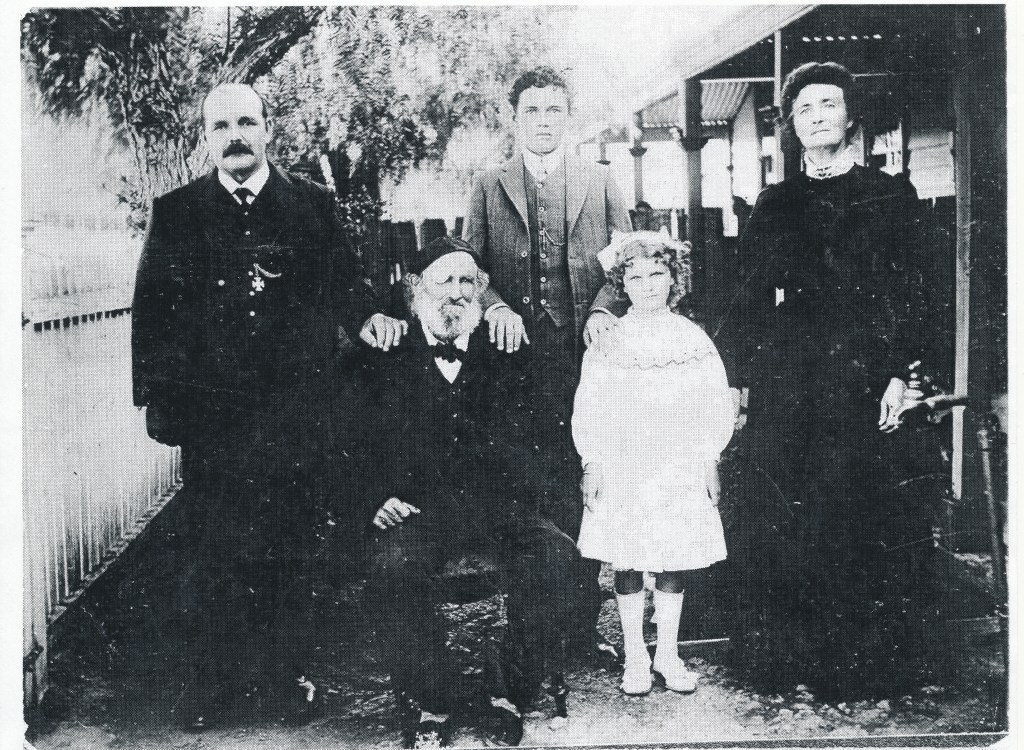
When age began to take its toll, Felix retired from farming. His great-nephew Joe Dempsey wrote the following about Felix in 1933:

He removed to Port Pirie where his second son, Michael, had settled and remained under the shelter of his roof until death claimed him, a sturdy and hardened example of pioneering fortitude, a venerable as well as venerated stalwart of the Faith, in 1912 at the advanced age of 87 years. His remains were conveyed to Mintaro and laid to rest amid relatives in the cemetery there.3


Standing: Michael Andrew Dempsey, Felix Patrick Dempsey, Rose Ann McGinnity. Seated in front, Felix Dempsey, the father of Michael Andrew Dempsey and grandfather of Felix Patrick Dempsey. The young girl is Elizabeth Charlotte Allen. Photograph taken in Port Pirie not long before the death of Felix Dempsey in 1912.

My next post will be about the service of Felix Patrick Dempsey in World War I.

  1. https://www.australianremembrancearmy.com/ ↩︎
  2. The Dempsey family is one of the families featured in this book. Lally, Gerald, A landmark of faith: Church of the Immaculate Conception Mintaro and its parishioners 1856-2006, Gerald A. Lally, Clare, S.Aust, 2006 ↩︎
  3. This is a traditional and powerful memento mori (a reminder of mortality) commonly found on 18th and 19th-century tombstones in English-speaking countries. ↩︎
  4. Joseph Dempsey, A Tribute to our Pioneer Ancestors: The Dempsey Family in South Australia, self-published, November 1933. Family collection. This book is also deposited in the National Library of Ireland and the GenealogySA Library. ↩︎

Anne Hayes, the daughter who was left behind

The Hayes family arrived in South Australia on 23 August 1849 on the ship Eliza. The passenger list recorded that they were from County Galway: Thomas and Honora Hayes, aged thirty-eight and thirty-four, and three children, Mary aged ten, Patrick aged nine and Thomas who was an infant. The child Patrick was my great-grandfather.

Given the age gap between Patrick and Thomas, I assumed that there may have been more children who perhaps did not survive the Famine. Further along in my research I discovered that there were three more children: a son John born in 1842 who probably died in infancy, another son named Michael, born circa 1843 and a daughter Anne, born in 1847. Michael, aged about six and Anne aged two were left behind, presumably in the care of relatives, when their parents emigrated. This practice was not uncommon and was the result of the restrictions the Emigration Commissioners placed on the number of children who could emigrate with their parents. The Hayes family’s application could have been rejected outright  if they had too many children under the age of ten. A fare of £2 was charged for the first two children, but £5 for any additional child. Families found a way to get around these regulations to minimise the fare they had to pay.[1] Sometimes a child from a large family was ‘given’ to a small family to make the voyage. Thomas and Honora’s circumstances must have been desperate for them to make this difficult decision. Michael and Anne later joined them in South Australia.

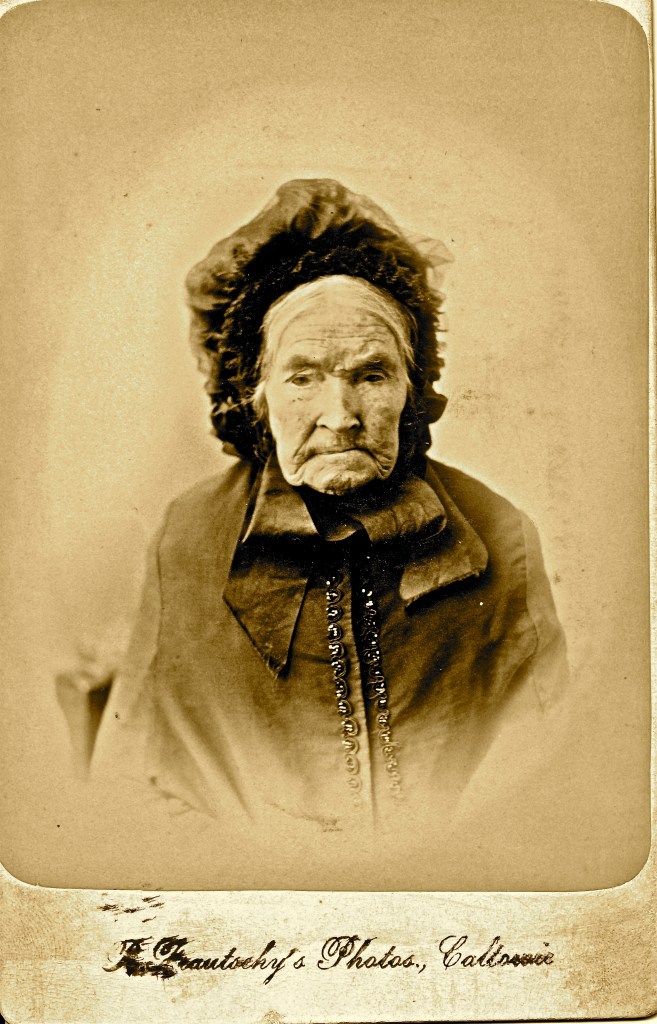
Honora Hennessy 1815–1899. This photograph taken in Caltowie towards the end of her life reveals a lifetime of hardship and sorrows. Of Honora’s 10 children, only Patrick and Anne left any descendants. Three of her children died in infancy.

Anne’s story

When and how Anne Hayes arrived in South Australia remains a mystery. There is a record for a passenger named Anne E Hayes, aged nineteen, servant from Limerick, who arrived on the Ocean Chief on 7 April 1864. She was a Remittance Emigrant. ‘Our’ Anne Hayes would have been aged seventeen. We cannot be certain that this is the correct record. Anne may have arrived with a family under another name or arrived in one of the other colonies and then travelled to South Australia.

On 18 March 1865 Anne Hayes married George Holmes at Saint John’s Catholic Church, Kapunda.[2] The marriage certificate has the following information: Anne was aged eighteen, a servant, from Kapunda, her father was Thomas Hayes and the witnesses were Patrick Hayes, farmer of the River Light and Anne Bolton, servant of the River Light. The celebrant was Father Thomas Dowling. Father Dowling filled out a form attached to the marriage certificate which affirms that Anne was a Catholic but George was not. Presumably George remained an Anglican and did not convert to Catholicism when he married Anne.

George Holmes, an able seaman from Dover, age twenty-eight, arrived on the Otago into Sydney on 9 January 1864.[3] George had been a mariner from the age of sixteen and may have made several voyages from England to Australia. He had an older brother John who was living in NSW at the time. Anne was not a passenger on Otago. It would be interesting to know where this young Irish girl and the seaman from Dover met, and when he gave up his maritime career and came to South Australia.

George Holmes & Anne Hayes. Date of photograph unknown. Author collection

George Holmes was christened at the Anglican church of St Mary the Virgin, Dover on 24 February 1835. There has been a church on this site since Saxon times. George had seven siblings who were all born in Dover. His mother Elizabeth was a pilot’s widow, his father having drowned while piloting the barque Harriot on a voyage from Quebec City to London on 25 December 1836. The ship was driven ashore and wrecked at Shakespeare Cliff, Dover, Kent with the loss of five of the twenty-four people on board.[4] Shakespeare Cliff derives its name from a reference in Shakespeare’s play King Lear. It lies along a stretch of the White Cliffs between Folkestone and Dover.

As I studied the Land Grant which my great grandfather Thomas Hayes had received in December 1858, I found that on 6 March 1865 he transferred Sections 242 and 243 in the Hundred of Belvedire to George Holmes of Kapunda, farmer. ‘Consideration money paid £588.’ The Land Grant was cancelled and a new Certificate of Title issued to George Holmes. This was an exciting discovery as it confirmed that Anne Hayes was indeed the daughter of Thomas and Honora, and that they were prepared to give up this good farming land for their daughter on the occasion of her marriage.

Land grant for Sections 242 and 243 in the Hundred of Belvidere to Thomas Hayes. Register Book Volume 3, Folio 36

George and Anne stayed on the land near Kapunda for only three years. On 2 April 1868 George transferred the property to Elizabeth Isabel Goodchild and the Holmes family moved to Auburn, a pretty village about 50 km from Kapunda in the direction of the Clare Valley. The name of Auburn is thought to come from a poem by Oliver Goldsmith, ‘Sweet Auburn, loveliest village on the plain.’ It is the birthplace of the poet, CJ Dennis (born 1876). He would have been a contemporary of some of the children of Anne and George.

Between the years 1865 and 1886 Anne Hayes had fifteen children, ten sons and five daughters. Two of the daughters were twins. Four of her sons died young. Her first child George died aged two years, James aged six months, Edward Alexander aged sixteen years and Henry died aged seven years. A fifth son, William Joseph died in 1896 aged twenty-two.

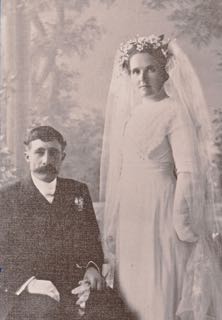
The wedding of Ann Katherine Holmes (1882-1966) and George Alfred Lapidge, St Patrick’s Church Undalya on 20 June 1912. Photograph courtesy of their daughter Margaret Morrison.

Anne drowned in the River Wakefield at Auburn at the age of 52 on 11 February 1900. Her youngest child Agnes was eleven years old. The inquest reads: ‘At Auburn, the 11th instant, on the body of Ann Holmes, who was found dead in the River Wakefield on the same date. Verdict – That the deceased was found drowned, and that there is no evidence to show how the deceased came into the water.’ Anne was buried in the cemetery at Undalya near Auburn.

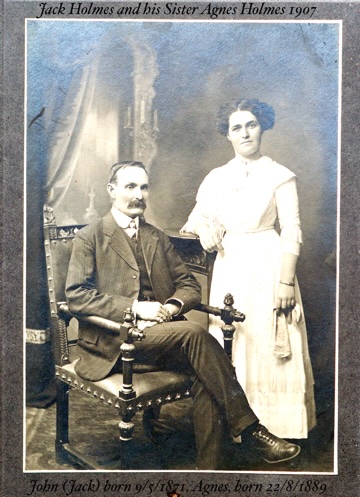
Jack Holmes (1871-1953) and his sister Agnes Holmes 1889–1980). Date of photograph 1907. Agnes was the youngest child in the family. She never married and looked after her father in his old age.


[1] Richard E. Reid, Farewell My Children: Irish Assisted Emigration to Australia 1848-1870, Anchor Books Australia, 2011, pp 19-21

[2] South Australian Marriages Registrations 1842 to 1916, Book/page 61/313. From the age on her marriage certificate, we can calculate Anne’s year of birth as circa 1847.

[3]An able seaman (AB) is a naval rating of the deck department of a merchant ship with more than two years’ experience at sea and considered ‘well acquainted with his duty’.

http://marinersandships.com.au/1864/01/026ota.htm

[4] https://en.wikipedia.org/wiki/List_of_shipwrecks_in_December_1836#25_December George’s mother died on 20 October 1887. She left a substantial will of £6,253.

An abandoned church evokes the spirit of my Dempsey ancestors

This article which I wrote recently has just been published in the May 2023 edition of The South Australian Genealogist.

This is the article.

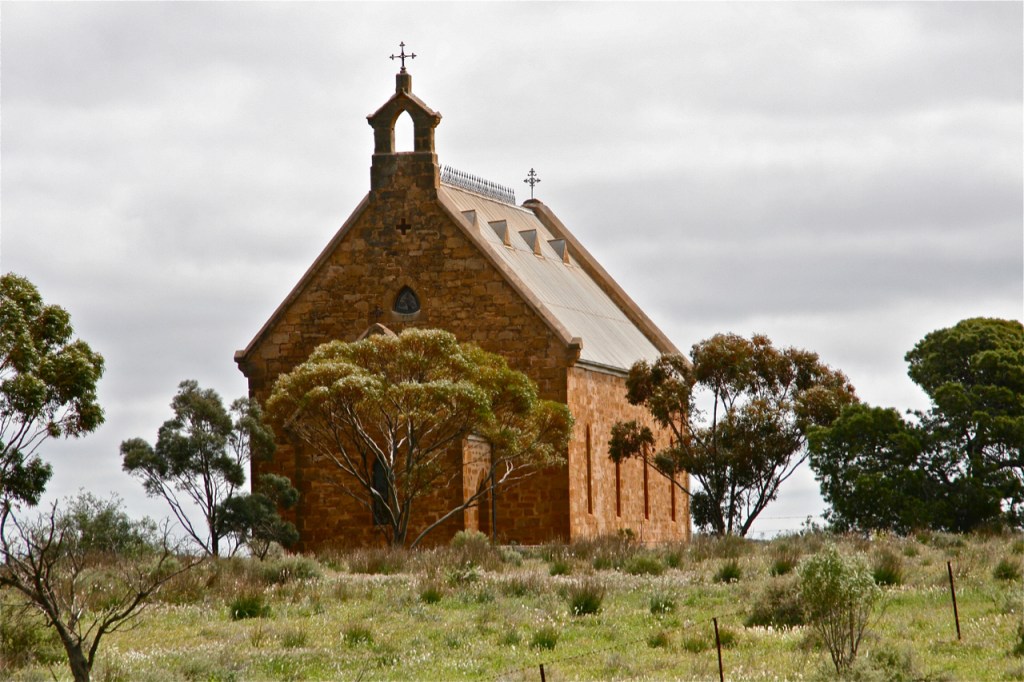
Our Lady of Mount Carmel Church, Dawson’ painted by Bruce Swan. Image courtesy of Steve Swan.

There is an evocative painting by South Australian landscape artist Bruce Swann, Our Lady of Mount Carmel, Dawson of a once beautiful small church standing alone in a dry landscape on a hot summer’s day. It is a forlorn symbol of the lost dreams of hard-working pioneers.

This church has a significant place in the history of my maternal ancestors, the Dempsey family. My great grandparents helped to build the church. Until I began researching my family history, I had never heard of Dawson or Our Lady of Mount Carmel Church. “Our Lady of Mount Carmel” is the name given to Mary in her role as patroness of the Carmelite religious order. The Carmelite order was founded on Mount Carmel in the 12th century. Mount Carmel is a coastal mountain range in northern Israel. Carmelite tradition has it that a community of Jewish hermits had lived at the site since the time of the prophet Elijah (900 BCE). Elijah is revered as the spiritual Father of the Order. Shortly after the Order was created a Carmelite monastery was founded at the site dedicated to the Blessed Virgin Mary.

Another Bruce Swan painting of Our Lady of Mount Carmel Church in Dawson, from a slightly different angle, was commissioned by the people of South Australia and presented to Pope John Paul II on his 1986 visit to Adelaide. It is now part of the Vatican collection. The Church is listed on South Australia’s Heritage Register with the following citation:

Dawson's Catholic Church, Our Lady of Mount Carmel, built in 1886 is of significance because it evocatively illustrates the pattern of settlement associated with the expansion of the agricultural frontier that occurred as a result of land reform from the mid 1870s. With extreme optimism, small farming communities were established far north of Goyder's Line of Rainfall and hamlets developed. In Dawson, this fine church was built, anticipating a thriving community. The architect for the building, Father John Norton is of significance as a competent architect turned priest and was responsible for several buildings in the region. Of course, the town of Dawson and its envisaged wheat farming community did not occur, beaten by years of drought in country best described as marginal. Dawson's Church evokes all of this history and stands in this barren landscape as a monument to the failure of the later Strangways resumptions.

The 1880s saw the construction of Methodist and Anglican churches as well as the Catholic church. The Dawson Hotel was built in 1883. A public school opened in 1885 after several years of agitation by local residents. Local government came to the area in 1888 with the District Council of Coglin which met alternately between Dawson and Lancelot. In its heyday, Dawson had multiple stores, an Institute, an agricultural bureau, and a blacksmith.

My great grandparents were among the unfortunate early settlers who tried farming outside Goyder’s Line of Rainfall. George Goyder was South Australia’s first Surveyor General who determined that land beyond a certain line was not suitable for agriculture as it lacked reliable rainfall. The government of the day ignored his warnings, and knowingly sold land to unsuspecting settlers. The countryside around Dawson has returned to its native vegetation, mainly salt bush and mallee scrub. Farmers run a few sheep. There is little trace left of the community who once lived there.

My grandfather, Patrick Joseph Dempsey was born on the family farm near Dawson on 17 July 1887, the second child of my great grandparents Andrew Felix Dempsey and Mary Ann Naughton. Their first child, a daughter named Mary Bridget, was born on 22 March 1886. She lived for only 11 days and was buried in the Dawson cemetery. In the photographs I have seen of my great grandmother as an old lady, she looks rather stern. I tried to imagine her feelings as a young woman, coping with the grief of losing her first child soon after birth. Altogether Mary Ann had eight children born near Dawson between 1886 and 1901.

Mary Ann Dempsey (nee Naughton) with her granddaughters Patricia and Mary Dempsey. My mother Mary Dempsey is the baby on her lap. 1915.

A few years ago I went on an ancestral journey of discovery in South Australia, visiting the places where my ancestors had once lived. Dawson was the last stop. We turned off the Barrier Highway north of Peterborough on to a rough dirt road. It did not look promising. There had been heavy rain that winter and we were nervous about getting bogged, an experience we had already encountered near Wirrabara. We wondered if we should continue or abandon our quest to find Dawson. As we passed the small cemetery, we could see it was not far to go so we decided to risk it. The remains of a solid hotel stand on the corner of the main intersection of what was once Dawson.

Dawson, with the ruins of the hotel on the left. 18 September 2016

What happened next was one of those serendipitous moments when I felt that the spirits of my ancestors were watching over me as I researched my family history. In that deserted landscape, a farmer appeared driving his ute with his working dog beside him. He stopped to chat and was naturally curious about what we were doing in Dawson. I told him about my interest in Our Lady of Mount Carmel Church and to my amazement he told me that I would find the keys hanging on a hook in the small community hall nearby and I could return them there when I had finished looking inside the church.

Our Lady of Mount Carmel Church, Dawson. 18 September 2016

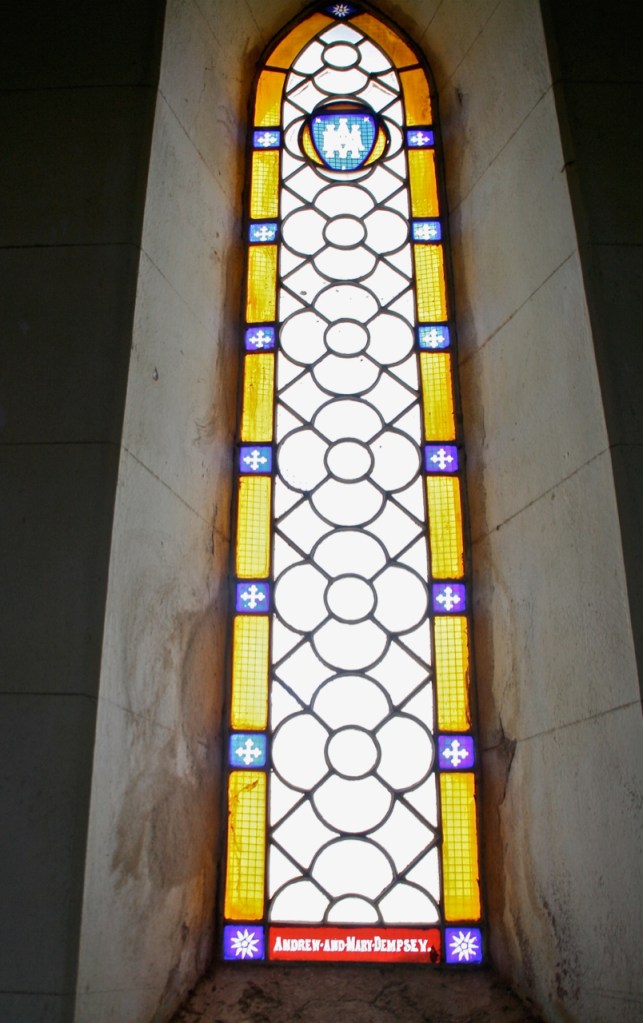
When I entered the church, I was moved to see one of the stained glass windows had been dedicated by my great grandparents “Andrew and Mary Dempsey”. I have visited many of the great cathedrals of Europe, but they did not move me as much as this small church in the bush. I felt a sense of grief and loss for my ancestors who had built this church and after a few years had to leave it behind when they were forced to abandon farming in this inhospitable environment.

The stained glass window donated to the church by my great-grandparents Andrew and Mary Dempsey

The last Mass was held in the Church in January 1970. More than 50 years since it was closed and 140 or so years since it was built, the Church building, its stained-glass windows and beautiful wood ceiling remain in good condition – a testament to the care with which it was constructed in 1885. The church’s architect was Father John Henry Norton.

John Henry Norton was born on the Ballarat goldfields in 1855. His father was English and his mother was Irish. As a young child he attended a Methodist Sunday School but later turned to his mother’s Catholicism. In 1870 he was received into the Church. Bishop Reynolds of the diocese of Adelaide sponsored his studies for the priesthood overseas. He was a student at St Kieran’s College, Kilkenny for two years and then a seminarian at the Propaganda College in Rome.  He received his Doctorate of Divinity from the College and was ordained  a priest on 8 April 1882. On his return to South Australia he was appointed to the parish of Petersburg, now Peterborough. Father Norton was responsible for designing several notable buildings in his parish. He was consecrated as Bishop of the then Port Augusta diocese at St Francis Cathedral, Adelaide on 9 December 1906. Bishop Norton had a close connection with the Dempsey family over many years. He officiated at the marriage of my great grandparents Andrew Felix Dempsey and Mary Ann Naughton at St Sebastian’s Church, Peterborough in 1884. He married my grandparents, Patrick Joseph Dempsey and Mary Lilian Howard at Our Lady of Dolours Church, Yongala in 1911. He also officiated at many Dempsey family baptisms and funerals. My mother did not leave behind many precious possessions, but there was one item which was very dear to her: a sepia-toned picture of the Sacred Heart in an oak frame which was a gift from Bishop Norton to my grandparents on their wedding day. My mother said in her memoir that the picture has a great deal of meaning for her and expressed the hope that some member of the family would take care of it when she was no longer able to do so.

Eventually my great grandfather Andrew Felix gave up trying to farm in the Hundred of Paratoo. His land was sold for less than the 10 per cent deposit paid on it. The Dempseys moved south and started anew, farming on land sub-divided on Old Canowie Station, between Whyte Yarcowie and Jamestown. Andrew Felix Dempsey purchased a property of 800 acres near Whyte Yarcowie for my grandfather. Grandpa was not given the land; he gradually repaid his father and by 1924 had succeeded in doing so.

My grandparents moved to this farm following their marriage in 1911. This is where my mother spent her childhood in great comfort and security. “It seemed to me, as a child, that the farm and home might well have been there for centuries. That’s how secure everything seemed to be.”

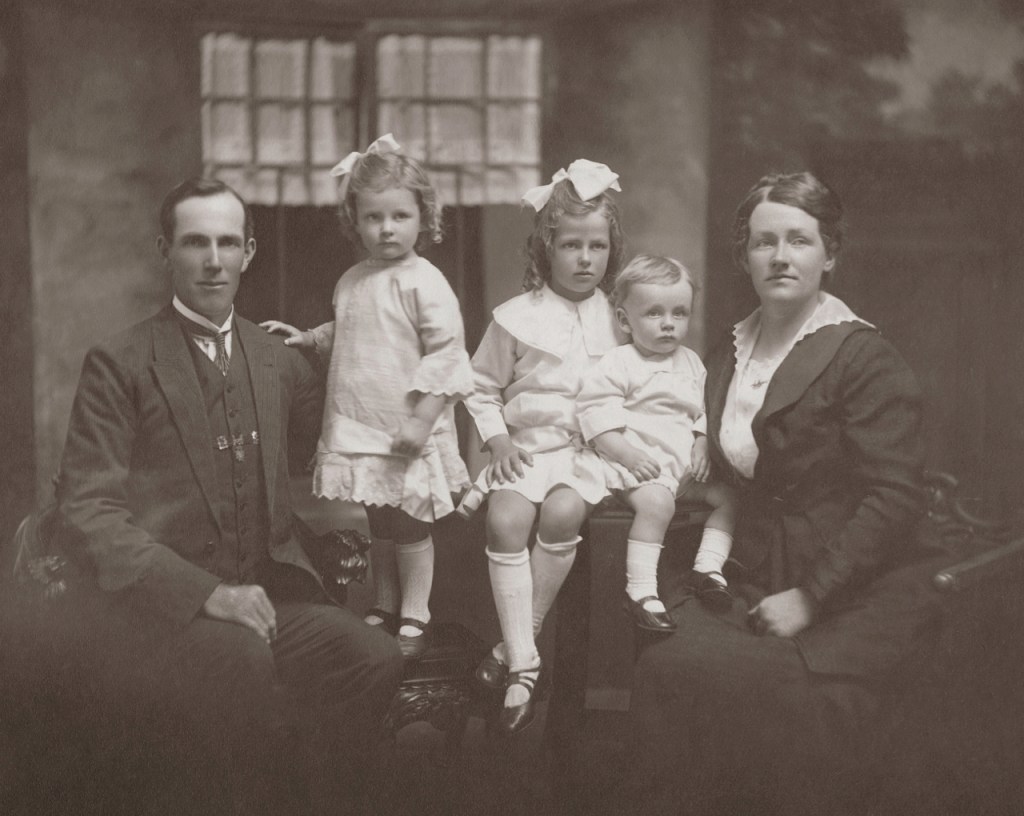
My grandparents Patrick Joseph Dempsey and Mary Lilian Howard with their children (left to right) Mary (my mother), Patricia and John. Photograph circa  1917-1918.

My grandfather had great devotion to Our Lady of Mount Carmel. His birthday coincided with her Feast Day and he named his farm near Whyte Yarcowie “Carmela” in her honour. He never forgot the church of his childhood. On the occasion of the closing of the church in January 1970, he wrote an article in the Witness, the monthly newspaper of the Port Pirie Diocese, expressing his sorrow. He recounted some amusing anecdotes about his days serving as an altar boy. He recalled that when he was a student at the Dawson Public School (the Catholic school had closed because of drought) the school had over 60 pupils on the roll book and “now there is no one living in the township of Dawson. What a mistake was made when the Government in defiance of the advice that Goyder gave them that they should not cut up for closer settlement any land outside Goyder’s line of rainfall. And now the lovely building is to be abandoned.” According to another correspondent in the Witness, Cardinal Norman Gilroy, during the time he spent as Bishop of Port Augusta 1935–1937,  was reported as saying that the Dawson church was like a small Cathedral in a desert.

A year following the closure of the Church my grandfather died aged 84 at the Little Sisters of the Poor, Myrtle Bank, Adelaide.

Sources

1.       ‘Bruce Swann: Australian realist landscape artist, 1925–1987’. Estate of Bruce Swan, https://www.bruceswann.com/landscapes.html

2.       Data SA, ‘Our Lady of Mount Carmel Church’, SA Heritage Places Database Search, https://maps.sa.gov.au/heritagesearch/HeritageItem.aspx?p_heritageno=16010

3.       Margaret M. Press, John Henry Norton: 1855–1923 Bishop of Railways, Wakefield Press, Kent Town, 1993.

4.     Joseph Dempsey, A Tribute to our Pioneer Ancestors: The Dempsey family in South Australia, Walkerville, 18 November 1933.

5.       Mary Imelda Dempsey, Carmela, a memoir, February–April 1995

6.       Witness. Catholic Monthly Newspaper of the Port Pirie Diocese. Vol XVI, No. 1, Pt Pirie, January 1970, p. 4

TT Reed Family History Book Award Winner

At a function held in Adelaide on 18 July my book Irish Settlers in South Australia: The Hayes and O’Toole Families was awarded the TT Reed Family History Book Award. This Award is made annually by the South Australian Genealogy & Heraldry Society to the person producing, in the opinion of the Society, the best family history in a given calendar year. 

The Award is named after Thomas Thornton Reed (1902-1995), Anglican Archbishop of Adelaide and a founder of GenealogySA in 1972.

The 2019 Award was not presented due to difficulties in judging as a result of the COVID-19 pandemic. The Society therefore decided to combine the histories submitted for 2019, and judge them jointly with those submitted for 2020. 

The judges made the following comments about my book:

Bernadette Thakur has crafted a well-rounded family history volume reflecting a great combination of research and storytelling. From the outset there is a good selection of consistent print styles, a good balance of images and maps to complement the text, all well supported by endnotes and an excellent bibliography. While there is good storytelling throughout the book, in relating the story of the Hayes family, the author showed real strength and artistry with the storytelling from her research. The history marries the family history with South Australian history, with excellent and comprehensive endnotes, reflecting the depth of research. The lengthy Appendix is quite complementary to the book and adds real value.

I was unable to be present for the occasion due to state border closures between SA and the ACT and NSW, but I attended via a Zoom link.

The Award was presented by Sue Lear, President of GenealogySA, and Andrew Peake, Chair of the Judges Panel.

Irish Settlers in South Australia: The first review of my book has been published!

A review of my book, Irish Settlers in South Australia: The Hayes and O’Toole Families was  published on 10 August 2020 in the online magazine Tintean. The reviewer is Dr Dymphna Lonergan, a researcher and media expert in the College of Humanities, Arts and Social Sciences at Flinders University.  https://orcid.org/0000-0002-2063-9931

From the review:

“[T]his is the story of Bernadette Thakur’s Hayes and O’Toole ancestors who migrated to South Australia in 1840 from Galway and County Wicklow.”

“This is also a handsome book”.

“This author’s style is varied and warm but grounded in truth-finding and truth-telling. The reader cannot help but appreciate the translation of dedicated scholarship into an easy read for those who might not have a personal connection with the people involved.

“Thakur says that ‘writing about my ancestors was very challenging as they left so little mark in the records. They were poor immigrants who arrived with nothing. They did their best to take care of their families and build new lives for themselves as farmers. Their story of honest hard work over many years is totally at odds with the generally negative stereotype of the Irish’. She has succeeded in lifting their lives out of the world of documents and photos. The book could be used as a template for writers’ groups in how to write a family history.

The full review can be found at the link below.

Irish Settlers in South Australia

A Winter Wedding

Rain was falling as my great-grandmother Catherine O’Toole woke up on the morning of Saturday 15 July 1865, but this did not dampen her spirits. Catherine was twenty-one years old, and this was her wedding day. It had been raining all week and her family had some distance to go to reach the church, St Mary’s in Mintaro. Catherine must have hoped they would not get bogged on the rough and slippery roads. The local correspondent for the newspaper reported that some very heavy rains had fallen within the last 24 hours, and “it still looks very gloomy with every appearance of more wet.”[1] His prediction of more rain was correct, for a few days later he reported “Since my last communication we have had constant rains with but few hours intermission.”[2]

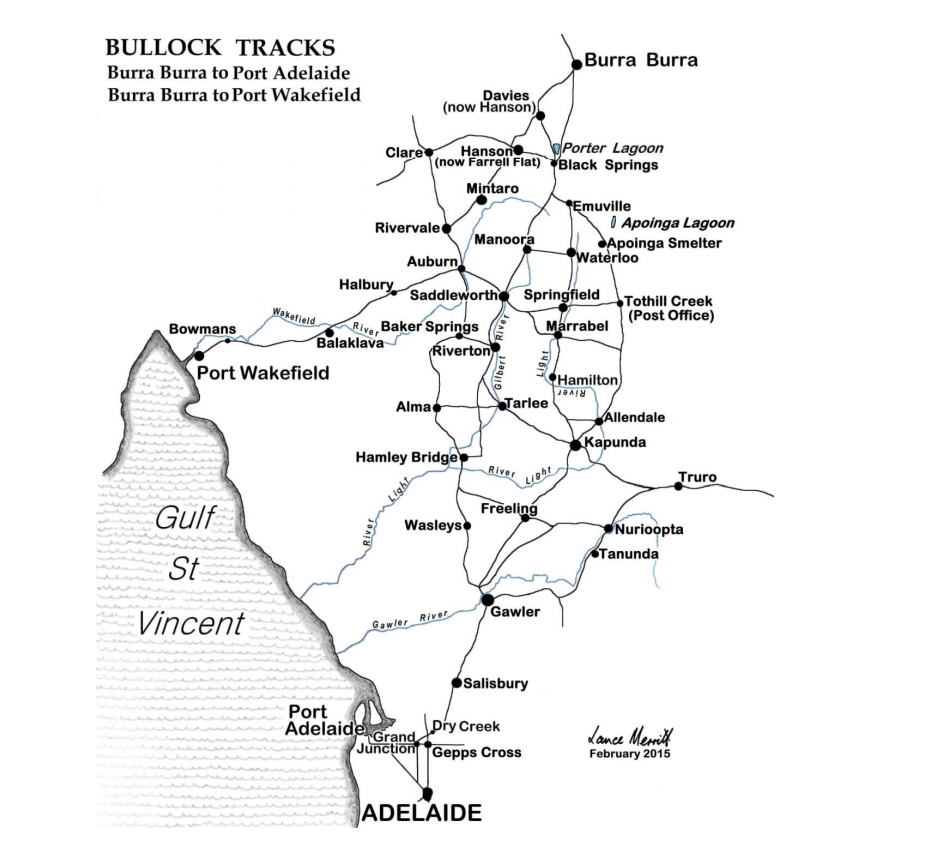
Catherine was born in Adelaide in 1844. Her parents, grandparents, aunt and uncles arrived in South Australia in 1840. They were Irish immigrants from County Wicklow. By 1865 Catherine was living with her parents and extended family on a farm in the Hundred of Apoinga, a few kilometres south of the big copper mine at Burra. There was no direct road to Mintaro and the O’Toole family would have travelled a circuitous route via Black Springs and Farrell Flat.

I wondered why St Mary’s Church was the location for the wedding as the O’Toole family did not have any connection with Mintaro. The answer could lie in an event which occurred a couple of years earlier. In April 1863, a joint wedding ceremony for Catherine’s sisters Mary and Margaret had taken place at the O’Tooles’ home in Apoinga. Perhaps Catherine thought that when it was her turn to marry, she would like to have a church ceremony. The nearest church was Saint Mary’s which opened on 23 November 1856.[3]

The young man she was to marry on this rainy day, Patrick Hayes, had arrived in South Australia in 1849 as a nine-year old boy with his parents, sister and infant brother. They were immigrants from County Galway. The experience of living through the Famine as a young child must have left memories which could not easily be forgotten and may have been a formative influence on his character.

It was customary for boys to begin working from about the age of fourteen, so Patrick was probably earning his keep from a young age. His father Thomas bought land near Kapunda in 1858, and thereafter Patrick helped his father on the land.[4] As well as helping the family with farming, Patrick wanted to earn his own income. He started working as a bullocky, carting copper between the mine at Burra to the railway terminus at Kapunda. He would have been very young to do this hazardous and dangerous work. Sometimes a load overturned on the rough roads, killing both bullocks and driver.

bullock-tracks-mapPatrick and Catherine may have met at Apoinga, one of the resting stops for the bullock teams.[5] Many of the bullockies were Irish and would have had connections amongst the Irish families living in the area. The bullock teams operated in spring and autumn – the summers were too hot for the animals and in winter muddy road conditions made carting heavy loads impossible. This could be the reason why a date in mid-winter was chosen for the wedding.
On 27 May 1865, seven weeks before the wedding, Patrick took out a lease for one of the sections owned by his father for a term of four years.[6] Patrick now had a place of his own to bring his young bride. He was on the path to independence.

The wedding

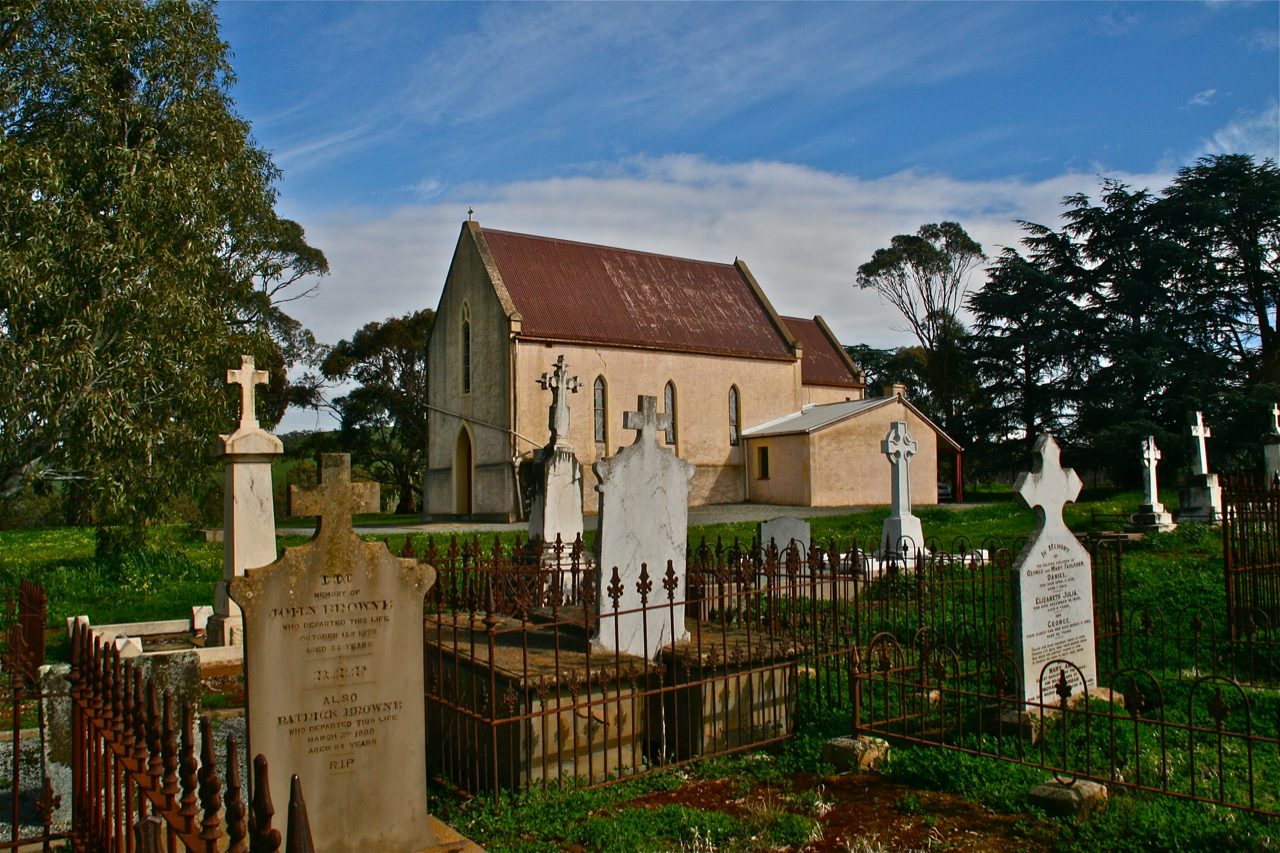
Catherine and Patrick were married by the Austrian Jesuit priest, Father Joseph Tappeiner. He was the district’s first parish priest and rode by horseback to Mintaro to say Sunday Mass once a fortnight.[7] The wedding was probably a solemn occasion with only family members present. Patrick and Catherine both signed the marriage certificate with their (x) mark. Patrick was illiterate but Catherine may not have been. She may have signed with her (x) mark as a symbol of solidarity with her husband.[8]

IMG_0295
St Mary’s Church, Mintaro (September 2016) Photo:Ramesh Thakur

Given the distance between Kapunda and Mintaro, I can’t be sure who from Patrick’s side of the family may have attended the wedding. Patrick was the eldest and his younger sisters were aged only eight and five. Given the cold and wet weather, I think it unlikely that they all would have travelled the distance, but perhaps his parents were there.

It may have been late in the day when the wedding was over and the weather continued to be intensely cold.[9] I imagine that Patrick and Catherine may have spent the night in one of Mintaro’s two hotels, the Magpie and Stump (1850) or the Devonshire Arms (1856). Perhaps they commenced the long journey to Kapunda after attending Sunday Mass at St Mary’s and receiving the congratulations of the parishioners.

I cannot help but think of my great-grandparents with affection. They were a young couple with hope in their hearts. I wonder about their conversation on the way to Kapunda as they planned their future together. Their 12th and youngest child was my grandfather, William Michael Hayes, born in 1890.

[1] ‘Mintaro’, Adelaide Observer (SA : 1843 – 1904) Saturday 15 July 1865, page 2

[2] Since my last communication we have had constant rains with but few hours intermission. It is at the present moment raining very heavily. It is to be hoped sincerely that the Far North may have had the same benefit conferred on it which we all in some measure feel. ‘Mintaro’, South Australian Register (Adelaide, SA : 1839 – 1900) 21 July 1865, page 4

[3] I have many ancestors buried in the graveyard of this church, but none from the Hayes or O’Toole families.

[4] 3 December 1858. Land Grant to Thomas Hayes for Sections 242 and 243, Hundred of Belvidere, County Light. Register Book 3, Folio 36. South Australian Integrated Land Information System (SAILIS) Historical Name Index Search 1858-1863, page 30. https://www.sailis.sa.gov.au/home/auth/login

[5] Apoinga Lagoon was an unexpected spread of fresh water in a dry region.

[6] The agreement was that £16 would be paid on 27 May each year. The section contained 72 acres. Memorial 141, Book 237. Old System Records, General Registry Office, Netley, Adelaide.

[7] Father Joseph Tappeiner arrived in South Australia from Austria in 1852. He was much beloved by his Irish parishioners. “At that period Mintaro and district contained a strong Irish element fresh from the ‘old land’, which is ever noted for the wonderful love of the Soggarth Aroon, (Gaelic for ‘dear priest’) but even in that country it would have been impossible to equal the bonds of affection which existed between the Irish settlers and the Austrian Jesuits.” Gerald A. Lally, A Landmark of Faith, Church of the Immaculate Conception Mintaro and its Parishioners 1856 – 2006, Clare South Australia 2006, p 10

[8] Catherine’s father John O’Toole witnessed the document with his (x) mark, but Margaret Larkin signed her name. If her younger sister Margaret could sign her name, it would seem to be highly likely that Catherine could also.

[9] ‘Kapunda’, Adelaide Observer (SA : 1843 – 1904) 15 July 1865, page 1

Is this it? Searching for Derrygoolin

My quest to discover my Irish ancestors began with my paternal ancestors, the Hayes family.  I learnt about the challenges of Irish family history research by studying my Hayes ancestors. The beginning was easy, looking at ship arrivals in South Australia. I soon discovered that they arrived in South Australia on 23 August 1849 on the ship Eliza. The passenger list recorded that they were from County Galway: Thomas and Honora Hayes, aged 38 and 34, and their three children, Mary aged 10, Patrick aged 9 and Thomas who was an infant.

Where had they come from in County Galway? This next step in my research was much harder. It took me the best part of a year to learn that they were from the townland of Derrygoolin, in the far south-eastern corner of County Galway, bordering on County Clare and Lough Derg. One day, I thought, I will go to this townland to see it for myself.

On a warm summer’s day in June this year, that day finally arrived. It was with a great sense of anticipation that we set off from Ennis and drove across the pleasant but unremarkable countryside of eastern County Clare, so different from the rugged and dramatic Atlantic coastline. From Scarriff we turned northwards to follow the shoreline of Lough Derg, a long narrow lake and the third largest in Ireland. We stopped along the way to get a closer look at the Holy Island of Inishcaltra and its ancient monastic site and Round Tower.

Soon after we crossed the Clare/Galway border, we turned on to a local road in what we hoped was the right direction. We knew that Derrygoolin was well off the beaten track and we wouldn’t find it near any main roads. We climbed slowly up the hills on the narrow road, through a spare and barren landscape, with no sign of any human habitation. There were a few cows resting in a rocky field and a clear view down to Lough Derg. We stopped, took a few photographs, and began to wonder “Could this be it? Was this Derrygoolin?”

Loch Derg
Cows grazing on the hillside, Derrygoolin townland, Co. Galway. Co. Tipperary is on the other side of Lough Derg


The GPS kept telling us we were nearly there. As we came down the hill, it guided us into a left turn on to what looked like a dead-end road. Sure enough, the road petered out into the entrance gate of an obvious farmhouse 50 metres away when the GPS told us: “After 80 metres on the left, you have arrived at your destination.” My husband and I looked at each other with a mixture of bafflement, consternation and merriment. Had our drive been in vain? All we could see was a secluded house, hidden behind a high stone wall, with a formidable large gate. It was the only house visible for miles around. It seemed worthwhile to try asking the owners if this was Derrygoolin.

As I approached the gate two dogs came running down the long driveway, barking ferociously. I stood wondering what to do and was about to leave when the figure of a woman appeared in the distance. She must have decided that I wasn’t a threat and began to walk hesitantly down the drive. By this time the dogs had decided that they liked me and were wagging their tails happily. When I explained my reason for stopping by, she confirmed that “Yes, this is Derrygoolin”.

We then proceeded into the village of Woodford about 5km away. With hindsight now I regret not stopping longer in Derrygoolin, to look around me, and reflect that it was on this land that my ancestors lived. It is difficult to imagine the family’s poor living conditions, let alone how they survived the Famine on this stony bare hillside.

Loch Derg
Derrygoolin townland, Co. Galway

This was the land where my great grandfather Patrick Hayes spent his first nine years.  What an exciting time it must have been for a young boy when the family made their way down to Cobh harbour to take a boat across to Plymouth, where they boarded the big ship, the Eliza on 11 May 1849, for their journey to the other side of the world. They travelled without family or friends, for there were only 22 Irish on board and 305 English passengers.

20180623_113829
The main street, Woodford village, Co. Galway

Woodford was a delight, charming and picturesque. The ladies in the public library on the main street were interested and friendly. The waitress in the café across the street was married to a Hayes. We found the graves of many deceased Hayes in the Catholic cemetery a short stroll up the hill. I felt that I was in Hayes territory.


20180623_113939
A stroll through Woodford village, as neat as a pin


The East Galway Family History Society had been very helpful to me in the early days of my research, and I wanted to see the Woodford Heritage Centre where it is located. The building itself is of historical interest as it was formerly a National School built in 1834. We were there on a Saturday and I expected the Centre to be closed, but to my surprise, the door was open. The people inside looked astonished when I stepped through the door, but in typical Irish fashion they were generous with their time and eager to help.

20180623_120231
Woodford Heritage Centre – the door is open!

It was another instance of the serendipitous events which occurred during my visit to Ireland where I felt the spirits of my ancestors were watching over me and helping me on my journey.

Woodford-Loghrea
Stopping to say hello to the horses outside Woodford. Derrygoolin and Lough Derg in the distance.

Woodford-Loghrea
Co. Galway Ireland

The Voyage of the Constance

The continuing story of the emigrants from the Shirley estate

The arrival of the Constance at Port Adelaide on 5 November 1849 caused a sensation in the shipping world. It had sailed in the record breaking time of 77 days, when the norm was closer to 120 days. It was the first (and last) government chartered vessel to sail the far southern latitudes of the Great Circle route. The British Admiralty was subsequently to prohibit government ships from sailing into the higher freezing latitudes close to the Antarctic. Of such fame was the voyage of the Constance that a painting of the ship was commissioned in 1853. It is held in the National Library of Australia.

Constance painting
The Constance, 578 tons, off Kerguelens Land, 20th October 1849, on her passage from Plymouth to Adelaide in 77 days. The artist was Thomas G Dutton.   Out of copyright. 

A voyage to forget

The voyage did not begin well. Within four days of leaving Plymouth on 19 August, there was sickness on the ship. Fever, diarrhoea, cholera and pleurisy had spread among the passengers. Before three weeks had elapsed, general sickness prevailed on board. The first death occurred only eight days after the voyage had started.

The Shirley emigrants from County Monaghan probably had no experience of sea travel. Not only was their journey from Plymouth to Adelaide an ordeal, but their passage from Dublin to Plymouth was not a good omen for what lay ahead of them. The surgeon superintendent on the Constance was later to report that the Shirley passengers had suffered severely from sea sickness on a rough Dublin–Plymouth steamer passage. Their relief at ultimately arriving on dry land in South Australia must have been immense.

For unknown reasons, Captain G B Godfrey decided to take the Great Circle Route, sailing down the coast of Brazil and South America into the higher latitudes close to the Antarctic, then east, where the ship caught the strong winds known as the “roaring forties” which blow around the Antarctic. Icebergs can occur at any time of the year but especially between May and October, making the area even more treacherous for shipping. The captain achieved a record sailing time, but the lives of the crew and passengers were put at risk.

clipper route to adelaide
Source https://goo.gl/images/ErKCs4

It is difficult to imagine what it must have been like for the passengers as the Constance battled mountainous seas and freezing temperatures in the southern latitudes. They would have stayed below deck, listening as the ship creaked and groaned and possibly wondering if the end of their days was nigh. It must have been a relief for them when the Constance sailed into the calm waters of St Vincent’s Gulf, and they were able to go on deck, see blue sky and feel the warmth of the sun.

Twenty three deaths, mainly from cholera, occurred during the voyage, a 9.4 per cent loss rate for the ship.[1] There was only one other ship with a higher death rate among 323 government-assisted voyages to South Australia between 1848 and 1885. It is remarkable that under epidemic conditions, the surgeon superintendent on board was able to contain the number of deaths to twenty-three. After arrival the passengers on the Constance declared their gratitude to the surgeon-superintendent for his attention.

Were they the victims of a nautical experiment or did illness on board influence the decision of the captain to sail the Great Circle Route? It is possible that if the captain had taken the usual but longer route, down the coast of Africa, round the Cape of Good Hope, and crossing the Indian Ocean, the death toll could have been higher.

Four more people died immediately after disembarking in Adelaide. Eleven others still suffering from fever were taken to the government funded Adelaide hospital. On recovery they were housed in the government Immigration Depot with their families. Another sixteen were visited at their lodgings by the Colonial Surgeon because the hospital was full.

Scapegoating the Shirley emigrants

The Destitute Board in Adelaide, which bore the cost of looking after the sick emigrants, was overwhelmed by the arrival of the Constance. The Board complained to Lieutenant Governor Sir H.E.F. Young, pointing the blame for the level of sickness amongst the passengers at the emigrants from the Shirley estate.

A great increase to the numbers receiving relief from the Destitute Board has taken place since the arrival of the “Constance” on 5th November, with Government emigrants. The greater part of the emigrants by this vessel were Irish and I am informed were in a very emaciated state when put on board in Plymouth in consequence of which low fever to a great extent, prevailed on board all the voyage . . . I am informed that nearly half those people were from one estate in Monaghan, and I beg leave to express an opinion that such a selection is highly objectionable, for considering the wretched state to which the peasantry of the south of Ireland have been reduced by famine and disease, it is not probable that a number of Irish emigrants, especially if taken from one neighbourhood, will be of that healthy and robust character so requisite in persons selected with the view of supplying the colony with an eligible description of labourers.

When I first read this critique, I pictured my ancestors disembarking in a bedraggled and emaciated state. And indeed, Peter Holland was admitted to Adelaide Hospital on 30 November, suffering continuous fever after 21 days in the colony.[2] Yet the criticism turned out to be unfair. Of the twenty one deaths on board, only four were from the Shirley emigrants: one adult woman and three children. Evidence was later produced that the Shirley emigrants had satisfied health criteria before departure.

The criticism of the Shirley emigrants received a strong rebuttal from the Shirley’s shipping agent in South Australia, in a letter to the Colonial Lands and Emigration Commission in London. In his letter, which is rather full of bluster and hyperbole, he denounced any claims that the Shirley estate was responsible for off loading persons unfit for such a voyage.

 ‘Mr Shirley’s emigrants’ letters teem with praises of South Australia: . . . they gloat in anticipation of their saving money, remitted it to their relatives, and being joined by them . . . the people sent by Mr Shirley were neither emaciated, ill provided, or ill suited for the colony of South Australia, but that on the contrary they were rough sturdy labourers, well provided for an ordinary passage to Australia, and I am delighted to assure you, by their letters, a well employed happy, moneymaking lot’.[3]

The journey of the Shirley emigrants on the Trafalgar in December 1849 was closer to the norm: their journey took 105 days and there was only one death on board.

There were no further efforts made to send out emigrants in a group from the Shirley estate to South Australia. Individuals and families later emigrated, following relatives who had preceded them, but there was no further organised emigration.Thereafter emigration to the United States became the most convenient and popular destination for all concerned.

There is a touching appeal from a tenant, Owen Corrigan, written from the workhouse in Carrickmacross to Evelyn John Shirley in 1852. Members of his family had sailed on the Trafalgar in December 1849:

I beg to remind you that in the month of December 1849 you were pleased to emigrate four of my family to Adelaide in Australia for which act you have earned their most fervent blessing as they state it’s second to no other country in the world . . . Shortly after they landed there they sent me [a sum of money] on receipt of which I moved my family from the Workhouse and did not return until I could hold out no longer.

His appeal for assistance to emigrate to South Australia was granted.

An ancestral bond is formed

Among the other Irish emigrants on the Constance was a family from County Tipperary: Cornelius Guidera, aged 24, Margaret Guidera aged 18, and Johanna Guidera age 13. Their story will follow in my next blog post.

There are no records to tell us what happened to these young people, the Hollands and the Guideras, in the years immediately after their arrival. They arrived penniless and without friends or relatives who could have lent them a helping hand. They would have had no choice but to obtain employment as quickly as they could, for new emigrants were expected to fend for themselves.

Two years after they arrived in South Australia, on 20 February 1852, my great great grandparents George Holland and Margaret Guidera were married at a Catholic Church in Adelaide. Their daughter Margaret was my great grandmother. She was born in 1861 on the family farm near Stanley Flat, a few miles north of Clare. I shall follow their story another time.

Peter Holland & Johanna Guidera
Peter Holland and Johanna Guidera.  The date of Peter’s photograph is unknown. The photograph of Johanna was taken in Broken Hill when she was in her seventies.

These two families were joined together in another marriage, when Peter Holland married Johanna Guidera on 26 January 1854 at St Patrick’s Church, Adelaide. Peter and Johanna were to have fifteen children. Peter died aged 53 (not 56 as appeared in the death notice in The Northern Argus, the local Clare newspaper). Their youngest child was only two years old. Johanna was left to raise her large family on her own. She was much beloved by her children and grandchildren. She died aged 83 in Shepparton, Victoria.

holland_peter-death-notice

Peter Holland grave
Peter Holland is buried on the hillside in the beautiful and historic St Aloysius cemetery at Sevenhill

Celtic Cross Catholic Cemetery Sevenhill
St Aloysius Cemetery, Sevenhill. Many of my relatives lie buried here.                                September 2016.  © Ramesh Thakur

[1] Robin Haines, Doctors at Sea, Emigrant Voyages to Colonial Australia, Palgrave MacMillan, 2005, p.27

[2] Trevor McLlaughlin, Stephanie James and Simon O’Reilley, Migration to Australia mid-nineteenth century: emigration from the Shirley estate at the time of the Famin, Clogher Record, Vol 20, No 2 (2010) p. 313

[3] Lorraine O’Reilly, ‘The Shirley estate 1814-1906 : the development and demise of a landed estate in County Monaghan’, [thesis], Trinity College (Dublin, Ireland). Department of History, 2014, pp 183-4