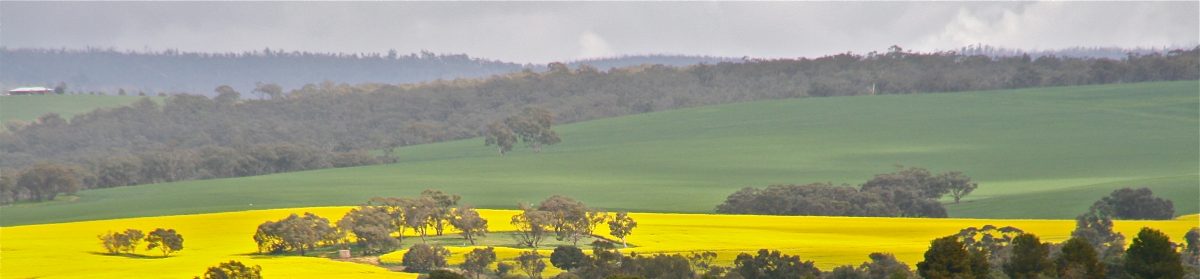
Felix’s life after his discharge from the Army
What Felix did in the years immediately after his discharge from the Army is unknown, for his name does not appear in any newspapers or other records. I like to think that he returned to Port Pirie, got a job and took care of his father in the final years of his life. Michael Andrew Dempsey died on 19 February 1925 in Port Pirie. We next hear of Felix when, on 1 December 1928, he married Alvera Hulda Falkenberg at a Registry Office in Adelaide. Felix was aged 32 and his bride was 22. Alvera was the fifth child of Julius Birthold Falkenberg and Emma Louise Kliche who had settled in the Barossa Valley. The marriage did not last, but I do not know when it ended.
This story does not have a happy ending, for in the 1930’s Felix’s life appears to have unravelled. The “shell shock” he suffered after serving on Gallipoli may have returned to haunt him. The term “shell shock” was coined in 1915 and is now recognized as post-traumatic stress disorder, PTSD, a psychological response to the stress of combat. Many soldiers who had witnessed trauma or experienced shell shock attempted to ‘self-medicate’ their symptoms with alcohol and drugs. PTSD had a long-term impact on many veterans of the First World War. At the end of this war the men who served in combat were not given any support to help them to return to civilian life. They suffered disabilities for the rest of their lives, including depression, alcoholism and severe social dislocation. They struggled to maintain relationships, jobs and general mental stability.
The generation of young men who fought in the First World War were hit with a second catastrophe in their lives with the arrival of the Great Depression. South Australia suffered more than any other state through the worst years of the Depression, with the official level of unemployment rising to 35.4% in 1932. Nationwide, the figure for unemployment reached a peak of 32% in 1932. By 1933 nearly one-third of breadwinners were unemployed.1 It seems quite likely, therefore, that Felix was one of many men who lost their jobs and became unemployed.
The added stress of unemployment could have been enough to lead Felix to despair. There were no unemployment benefits in the 1930s. Suicide rates increased dramatically. Studies have shown a direct causal relationship between unemployment and suicide rates, not just during the Depression, but still occurring today.2
Records show numerous instances of Felix getting into trouble with the police in the 1930s. For example, in July 1934 Felix was in the Police Court in Mount Barker.
On Monday morning, Felix Patrick Dempsey, travelling tool sharpener, was brought before Mr. G. A. I. Liebing and charged with being a “noisy drunk.” He was arrested on Saturday night.
Sergt. Koch, in evidence, stated, that the defendant was a noisy, pugilistic drunk, who had many previous convictions against him for vagrancy, and only last month he was released from gaol after having served three months for larceny.
The bench imposed a fine of £1 and 4/ costs, in default 7 days imprisonment in the Adelaide gaol. The defendant elected to take the time out.3
This newspaper report tells us that Felix did not have a regular job: he was trying to support himself as a “travelling tool sharpener”. He had previous convictions for vagrancy. During the Depression many thousands of men were “vagrants”, wandering from place to place desperately seeking work and sleeping in public parks. More than 40,000 men moved around the country looking for work: setting up shantytowns on the edges of communities and camping in parks.4
In September 1937 Felix was sentenced to five months imprisonment for stealing a bicycle. He would have been in prison when his mother died on 12 December 1937.
Felix Patrick Dempsey, laborer, of Franklin Street, city, who admitted 28 previous convictions, was sentenced to imprisonment for five months by Mr Morgan. S.M. in the Adelaide Police Court yesterday, for having, on September 4 stolen a bicycle valued at £3, the property of the Adelaide Wine and Spirit Coy.. Ltd. Assistant Police Prosecutor Dayman prosecuted.5
By 1939 Felix was in New South Wales in the small town of Grong Grong about 23 km east of Narrandera in the Riverina region. I remember Narrandera as a pleasant place to stop on the long drive from Canberra to Adelaide, but I wonder what purpose Felix had in this place in 1939, or if he was just a lost soul drifting through. On 6 January Felix Patrick Dempsey (45) was fined £1/10/, in default three days, on a charge of drunkenness at Grong Grong.6
With the outbreak of the Second World War, Felix enlisted again, on 11 December 1940, this time with the 8th Garrison Battalion at Shortland Camp, New South Wales. The 8th Garrison Battalion was responsible for coastal defence in and around the Newcastle region.
He was discharged on 5 February 1941. His record does not give reasons for his discharge. He would have been aged 47.
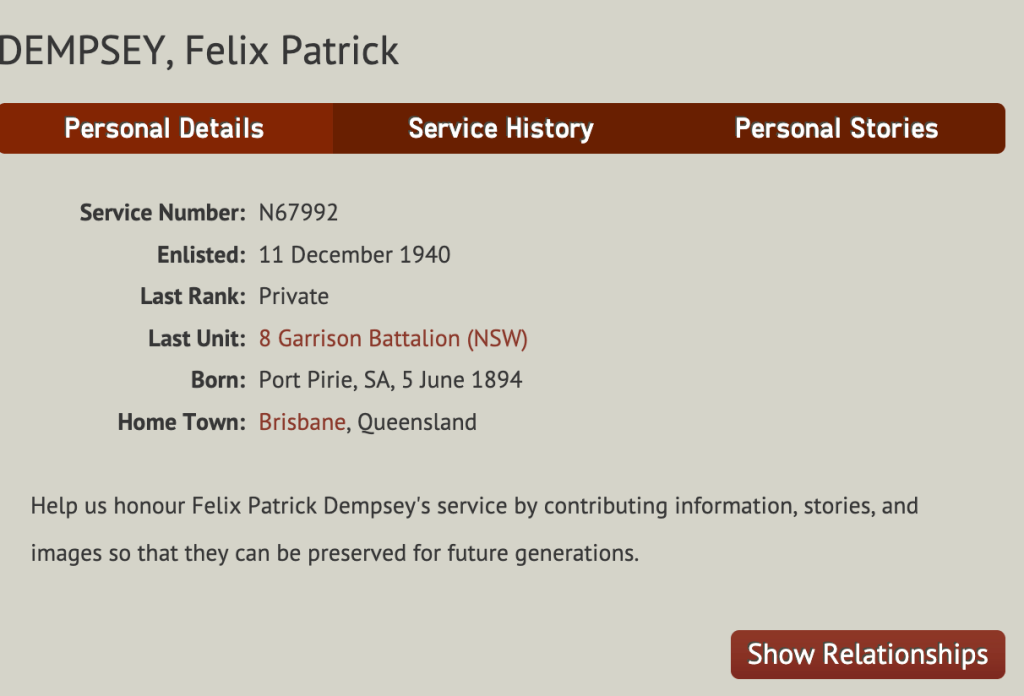
He died in Brisbane Hospital the following year of “alcoholic leptomeningitis” which generally refers to the increased severity of bacterial meningitis in patients with chronic alcohol use disorder. His death certificate said that he was single, had no relatives, and lived at Moorooka Camp, a large Military camp set up by the United States Army Service of Supply during the Second World War.
While reading about the long-term disabilities suffered by World War I veterans, I came across an article which resonated with me.
Overall, we have a better understanding of what trauma is because of World War I. Although modern treatments for PTSD are more effective than those for shell-shock, issues such as social stigma and alcohol misuse remain. These are lessons from World War I we are still learning. We must not forget the challenges facing service personnel exposed to trauma, both today and a century ago.7
Felix Patrick Dempsey’s burial place in Toowong Cemetery is far from his family roots in Ireland and South Australia. Toowong Cemetery was established in 1866. It is a beautiful heritage listed cemetery, established on a hilly site at the base of Mt Coot-tha. It is set on a unique scenic landscape with numerous walking trails. The Friends of Toowong Cemetery conduct tours and provide self-guided walks through the cemetery. One day soon – for I live not far from Brisbane – I will visit Felix’ grave to pay my respects. As I stand in front of his grave, I will tell him that he has not been forgotten, that he has family who still remember him with affection and respect.
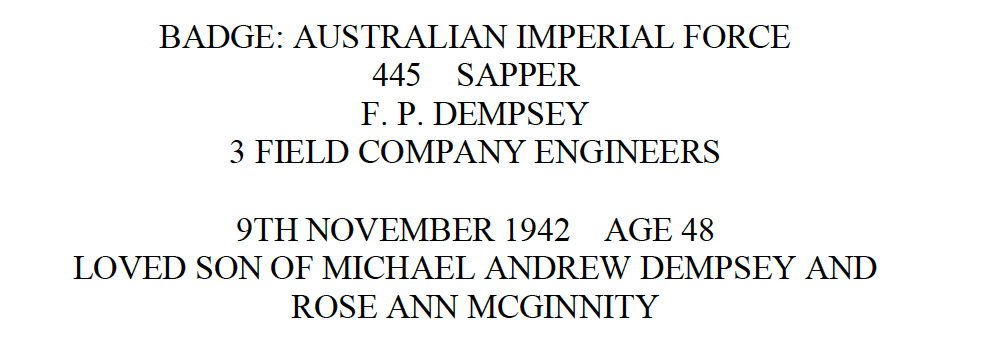
I have been informed by the Office of Australian War Graves that the official plaque on Felix Patrick Dempsey’s grave will be inscribed as follows:
Lest We Forget
- Clark, Manning A short history of Australia (Fourth revised edition). Penguin Group Australia, Camberwell, Victoria, 2006, p. 266 ↩︎
- A study using data from 175 countries between 1991 and 2017 showed that for every 1% increase in unemployment, there was a 2–3% increase in suicide rates. Mark Sinyor, Morton Silverman, Jane Pirkis, Keith Hawton. “The effect of economic downturn, financial hardship, unemployment, and relevant government responses on suicide”, The Lancet Public Health, Volume 9, Issue 10, 2024, pp. 802–06. ↩︎
- “POLICE COURT, MOUNT BARKER.” The Mount Barker Courier and Onkaparinga and Gumeracha Advertiser (SA : 1880 – 1960) 20 July 1934: 2. Web. 30 Apr 2026 <http://nla.gov.au/nla.news-article146056566>. ↩︎
- National Museum of Australia, https://www.nma.gov.au/defining-moments/resources/great-depression ↩︎
- “Prison For Stealing Cycle” The Advertiser (Adelaide, SA : 1931 – 1954) 11 September 1937: 30. Web. 30 Apr 2026 <http://nla.gov.au/nla.news-article30776182>. ↩︎
- “MONDAY, JANUARY 2” Narandera Argus and Riverina Advertiser (NSW : 1893 – 1953) 6 January 1939: 1. Web. 30 Apr 2026 <http://nla.gov.au/nla.news-article130464164>. ↩︎
- Benjamin Russell Butterworth, Glasgow Caledonian University. “What World War I taught us about PTSD”.The Conversation https://theconversation.com/what-world-war-i-taught-us-about-ptsd-105613 ↩︎
 My Irish Ancestors in South Australia