The Hayes family arrived in South Australia on 23 August 1849 on the ship Eliza. The passenger list recorded that they were from County Galway: Thomas and Honora Hayes, aged thirty-eight and thirty-four, and three children, Mary aged ten, Patrick aged nine and Thomas who was an infant. The child Patrick was my great-grandfather.
Given the age gap between Patrick and Thomas, I assumed that there may have been more children who perhaps did not survive the Famine. Further along in my research I discovered that there were three more children: a son John born in 1842 who probably died in infancy, another son named Michael, born circa 1843 and a daughter Anne, born in 1847. Michael, aged about six and Anne aged two were left behind, presumably in the care of relatives, when their parents emigrated. This practice was not uncommon and was the result of the restrictions the Emigration Commissioners placed on the number of children who could emigrate with their parents. The Hayes family’s application could have been rejected outright if they had too many children under the age of ten. A fare of £2 was charged for the first two children, but £5 for any additional child. Families found a way to get around these regulations to minimise the fare they had to pay.[1] Sometimes a child from a large family was ‘given’ to a small family to make the voyage. Thomas and Honora’s circumstances must have been desperate for them to make this difficult decision. Michael and Anne later joined them in South Australia.
Anne’s story
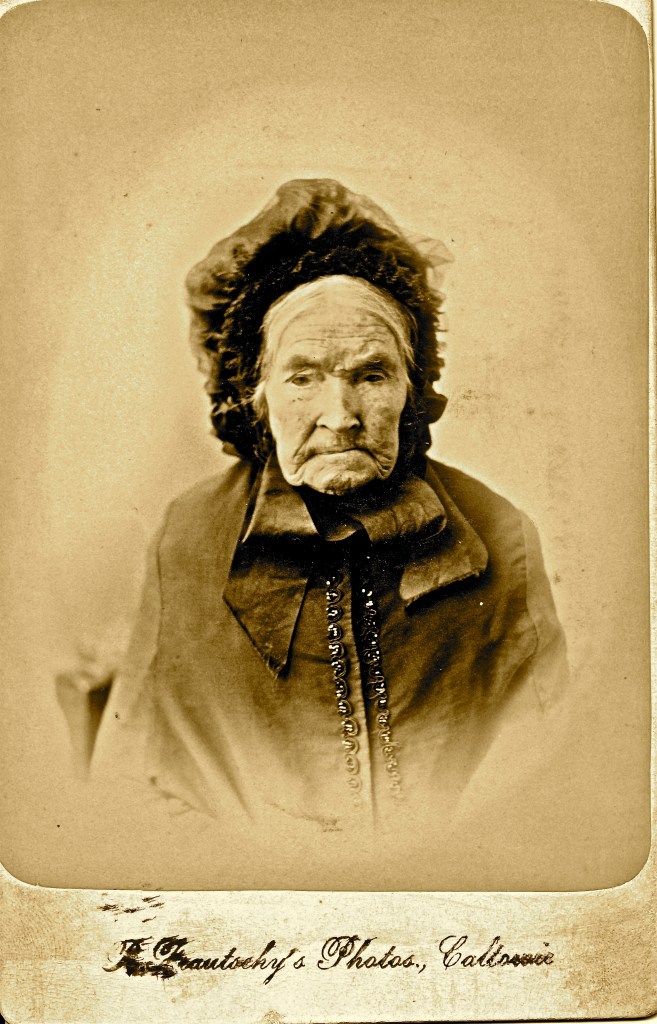
When and how Anne Hayes arrived in South Australia remains a mystery. There is a record for a passenger named Anne E Hayes, aged nineteen, servant from Limerick, who arrived on the Ocean Chief on 7 April 1864. She was a Remittance Emigrant. ‘Our’ Anne Hayes would have been aged seventeen. We cannot be certain that this is the correct record. Anne may have arrived with a family under another name or arrived in one of the other colonies and then travelled to South Australia.
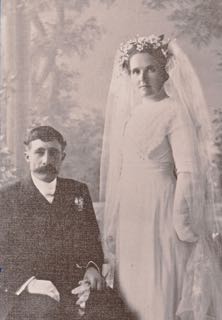
On 18 March 1865 Anne Hayes married George Holmes at Saint John’s Catholic Church, Kapunda.[2] The marriage certificate has the following information: Anne was aged eighteen, a servant, from Kapunda, her father was Thomas Hayes and the witnesses were Patrick Hayes, farmer of the River Light and Anne Bolton, servant of the River Light. The celebrant was Father Thomas Dowling. Father Dowling filled out a form attached to the marriage certificate which affirms that Anne was a Catholic but George was not. Presumably George remained an Anglican and did not convert to Catholicism when he married Anne.
George Holmes, an able seaman from Dover, age twenty-eight, arrived on the Otago into Sydney on 9 January 1864.[3] George had been a mariner from the age of sixteen and may have made several voyages from England to Australia. He had an older brother John who was living in NSW at the time. Anne was not a passenger on Otago. It would be interesting to know where this young Irish girl and the seaman from Dover met, and when he gave up his maritime career and came to South Australia.

George Holmes was christened at the Anglican church of St Mary the Virgin, Dover on 24 February 1835. There has been a church on this site since Saxon times. George had seven siblings who were all born in Dover. His mother Elizabeth was a pilot’s widow, his father having drowned while piloting the barque Harriot on a voyage from Quebec City to London on 25 December 1836. The ship was driven ashore and wrecked at Shakespeare Cliff, Dover, Kent with the loss of five of the twenty-four people on board.[4] Shakespeare Cliff derives its name from a reference in Shakespeare’s play King Lear. It lies along a stretch of the White Cliffs between Folkestone and Dover.
As I studied the Land Grant which my great grandfather Thomas Hayes had received in December 1858, I found that on 6 March 1865 he transferred Sections 242 and 243 in the Hundred of Belvedire to George Holmes of Kapunda, farmer. ‘Consideration money paid £588.’ The Land Grant was cancelled and a new Certificate of Title issued to George Holmes. This was an exciting discovery as it confirmed that Anne Hayes was indeed the daughter of Thomas and Honora, and that they were prepared to give up this good farming land for their daughter on the occasion of her marriage.

Land grant for Sections 242 and 243 in the Hundred of Belvidere to Thomas Hayes. Register Book Volume 3, Folio 36
George and Anne stayed on the land near Kapunda for only three years. On 2 April 1868 George transferred the property to Elizabeth Isabel Goodchild and the Holmes family moved to Auburn, a pretty village about 50 km from Kapunda in the direction of the Clare Valley. The name of Auburn is thought to come from a poem by Oliver Goldsmith, ‘Sweet Auburn, loveliest village on the plain.’ It is the birthplace of the poet, CJ Dennis (born 1876). He would have been a contemporary of some of the children of Anne and George.
Between the years 1865 and 1886 Anne Hayes had fifteen children, ten sons and five daughters. Two of the daughters were twins. Four of her sons died young. Her first child George died aged two years, James aged six months, Edward Alexander aged sixteen years and Henry died aged seven years. A fifth son, William Joseph died in 1896 aged twenty-two.
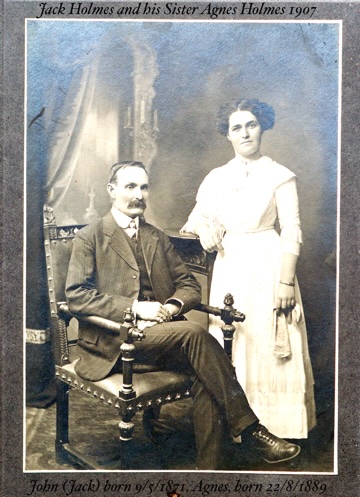
Anne drowned in the River Wakefield at Auburn at the age of 52 on 11 February 1900. Her youngest child Agnes was eleven years old. The inquest reads: ‘At Auburn, the 11th instant, on the body of Ann Holmes, who was found dead in the River Wakefield on the same date. Verdict – That the deceased was found drowned, and that there is no evidence to show how the deceased came into the water.’ Anne was buried in the cemetery at Undalya near Auburn.
[1] Richard E. Reid, Farewell My Children: Irish Assisted Emigration to Australia 1848-1870, Anchor Books Australia, 2011, pp 19-21
[2] South Australian Marriages Registrations 1842 to 1916, Book/page 61/313. From the age on her marriage certificate, we can calculate Anne’s year of birth as circa 1847.
[3]An able seaman (AB) is a naval rating of the deck department of a merchant ship with more than two years’ experience at sea and considered ‘well acquainted with his duty’.
http://marinersandships.com.au/1864/01/026ota.htm
[4] https://en.wikipedia.org/wiki/List_of_shipwrecks_in_December_1836#25_December George’s mother died on 20 October 1887. She left a substantial will of £6,253.
 My Irish Ancestors in South Australia